
AI is On the Path to Becoming a Regulated Category.
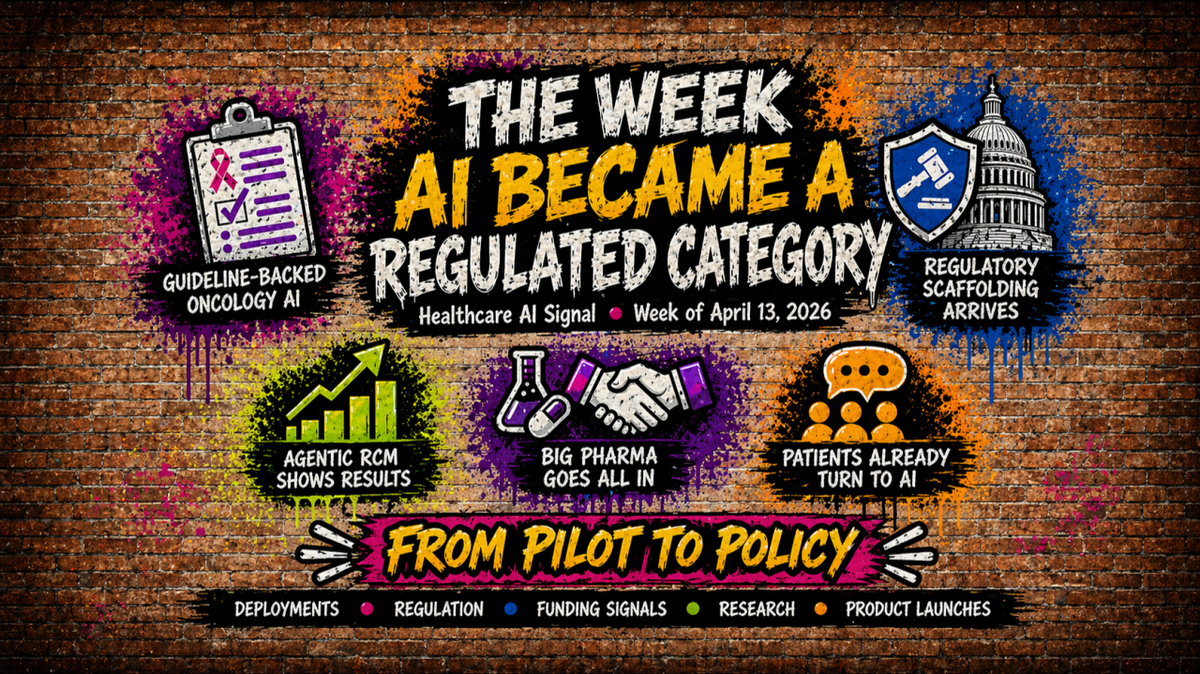
This week the regulatory scaffolding for American healthcare AI arrived in a single five-day stretch. NCCN embedded an AI-derived risk threshold in cancer screening guidelines. FDA validated its first AI drug development tool. CMS wrote a national reimbursement pathway for a specific AI model. HSCC, IMDRF, ACCME, and five state legislatures all moved on AI-specific rules. A lot of outlets treated CMS's ACCESS Model as the AI signal of the week. It isn't. ACCESS is technology-neutral and mostly non-AI. The real signal was in the guideline and validation machinery, the part of healthcare that decides what gets used, paid for, and defended in a board meeting.
NCCN Embedded AI in Cancer Screening Guidelines. Did the Pilot Era for Oncology AI Just End?
🔴 Policy / Regulation | Score: 8.5 | View Article
Why It Matters NCCN's 2026 breast cancer screening guidelines now include Clairity Breast, an FDA-authorized AI model that analyzes screening mammograms to produce a 5-year risk score. The guidelines establish a ≥1.7% AI-derived 5-year risk threshold to flag higher-risk patients and guide supplemental imaging. This is the cleanest pure-AI signal of the week: a named, FDA-authorized model embedded in the most influential oncology guideline body in the country, with a specific numerical threshold driving clinical action.
Key Details
- Organizations: NCCN, Clairity, FDA
- Model: Clairity Breast: FDA-authorized, mammography-based 5-year risk score
- Threshold: ≥1.7% AI-derived 5-year risk triggers supplemental imaging and reassessment
- Scope: 2026 NCCN Breast Cancer Screening and Diagnosis Guidelines
- Source: OncLive
What This Signals AI has crossed from pilot tool to evidence-based protocol. Mammography programs that ignore guideline-backed AI will face adherence scrutiny within the year. More importantly, NCCN just built the template and ASCO, ASH, and ACC will face pressure to evaluate AI in their specialties next.
My Read: The threshold number is the tell. 1.7% is not a vibe, not a marketing figure, not a vendor benchmark, it is a clinical trigger that NCCN is willing to defend. Every prior "AI in breast imaging" story argued whether models worked. This story confirms the guideline system has already decided they do. The political work this is doing inside every radiology department runs like this: the chief now has to explain to her board why her screening program is not using a guideline-backed AI risk model. The NCCN committee did not need to include Clairity by name to make its point; the fact that they did is the signal about how confident they are in FDA-authorized clinical AI as a category. Watch for three follow-on moves: commercial payer coverage tied to guideline language, radiology PACS vendors accelerating AI partnerships, and competing risk models pivoting their clinical trial strategies to chase NCCN inclusion as their next milestone. The path from FDA authorization to guideline inclusion is shorter than most AI companies priced into their strategy.
Children's Healthcare of Atlanta CIO Publishes the Year's Most Honest AI Deployment Playbook
🔴 Real-World Deployment | Score: 8.5 | View Article
Why It Matters After opening a highly instrumented hospital with autonomous delivery robots and AI-driven workflow tools, the CIO at Children's Healthcare of Atlanta sat down and named the adoption gap out loud. Not the tech. The adoption gap. The piece reads like an honest field report from the other side of the go-live moment, and it is the most useful operator document on healthcare AI published this quarter.
Key Details
- Organization: Children's Healthcare of Atlanta
- Deployment: Autonomous delivery robots, integrated digital systems, AI-driven workflows
- Stage: Post go-live, multiple months into operations
- Focus: Lessons on adoption, utilization, and clinician-centric integration
- Source: Healthcare IT News
What This Signals The operator edge in 2026 is not procurement, it will be post-deployment engineering. The health systems winning with AI are running integration programs, not tech rollouts. The ones failing are still measuring installation instead of utilization.
My Read: Most healthcare AI failure modes this year are not model failures. They are adoption failures, and nobody wants to say that out loud because it implicates the buyer, not the vendor. The robot gets installed. Clinicians work around it. Throughput does not move. The dashboard still shows green because the metric is "deployed," not "used." This CIO said the quiet part loud: utilization is the only number that matters. The pre-deployment simulation approach he describes is the kind of discipline that separates systems who are going to make AI work from systems who are going to spend the next three years wondering where the ROI went. If your AI portfolio review this quarter does not include utilization rates by tool, you are running a procurement report, not a deployment review. The hospital executives who read this piece and change nothing are the ones whose AI budgets will be cut in 2027.
Nature Just Published the First Real Map of Where Healthcare AI Money Actually Went
🔴 Funding Signal | Score: 8.5 | View Article
Why It Matters A peer-reviewed Nature analysis classified 3,807 AI health startups founded 2010–2024 across five complexity tiers, mapping each by medical domain, funding, geography, and founding team. Two-thirds of cumulative investment landed in clinical decision support, drug discovery, and diagnostics. Mental health, rehabilitation, and public health are materially underfunded. For the first time, the sector has a defensible denominator instead of a market-research projection.
Key Details
- Scope: 3,807 AI health startups, 2010–2024
- Framework: Five-tier AI systems complexity classification
- Headline finding: Two-thirds of capital in CDS, drug discovery, and diagnostics
- Underfunded domains: Mental health, rehabilitation, public health
- Source: Nature / npj Digital Medicine
What This Signals The supply side of healthcare AI is structurally skewed toward high-complexity, high-reimbursement, high-IP-defensibility categories. Operators building in underserved domains will face thinner vendor markets. Investors chasing crowded categories will face compression. Markets alone will not correct this.
My Read: The interesting number is not the two-thirds. It is the underfunded categories. Mental health and public health are the two domains where AI could plausibly create the most patient-level value per dollar, and they are where the fewest dollars have gone. That is not a coincidence; it is a reimbursement-clarity and IP-defensibility problem. Which means it is a policy problem, not a market problem, and nobody funds their venture strategy on that distinction. CMS's ACCESS Model happens to cover depression, and at least two of its participants (Curai, Slingshot AI) are AI-first. If the ACCESS outcome-based structure produces real data for AI-driven depression care, it could do more to correct the capital distribution Nature just documented than a decade of venture cycles will. Health system investors and corp dev teams should treat this paper as the market map they have been asking analysts for and stopped getting honest answers about.
R1 Publishes Named-Site Agentic RCM Metrics. The Hype Gap in Revenue Cycle AI Just Closed a Bit.
🔴 Real-World Deployment | Score: 7.8 | View Article
Why It Matters R1 expanded its Phare OS platform with agentic denials management, opened R37, its New York AI lab. They reported live deployment metrics at named health systems: up to 50% faster appeal times and over 77% inpatient coding accuracy at Providence and Singing River Health System. These are the first public agentic AI metrics from named providers at scale in the RCM category.
Key Details
- Vendor: R1 RCM (plus R37 AI lab)
- Named providers: Providence, Singing River Health System
- Outcomes: Up to 50% faster appeals, >77% inpatient coding accuracy
- Capability: Agentic denials management, autonomous coding
- Source: GlobeNewswire
What This Signals Back-office agentic AI is exiting the hype cycle. The procurement conversation in RCM is shifting from "does agentic AI work" to "why is your vendor's number lower than R1's?"
My Read: The 77% coding accuracy figure is the one that reprices the whole vendor landscape. Any agentic RCM vendor citing a lower accuracy number on simpler workflows now has to explain the gap. Any vendor citing a higher number without named sites has to explain why R1's production environments with Providence and Singing River are harder than theirs. R1 knows what they did with this press release, they built a public benchmark that competitors have to meet or answer for. The R37 lab opening is the quieter signal: RCM incumbents are now making AI R&D investments at the scale that used to belong to health IT startups. The category is consolidating toward a short list of vendors who can run agentic systems in production with named-site accountability. Everyone else is about to be a feature, not a platform.
FDA Validated Its First AI Drug Development Tool. Pharma Just Got a Regulatory Green Light.
🔴 Policy / Regulation | Score: 8.0 | View Article
Why It Matters The FDA validated AIM-NASH as its first AI-enabled drug development tool, for histologic measurement of nonalcoholic steatohepatitis. This is not a device clearance, it is validation of an AI tool inside the drug development pipeline. The precedent matters more than the tool.
Key Details
- Tool: AIM-NASH
- Use: Automated histologic measurement of NASH
- Regulatory status: First FDA-validated AI-enabled drug development tool
- Implication: Precedent for AI in clinical trial endpoints and pharma pipelines
- Source: University of Cincinnati
What This Signals FDA has now formally acknowledged that an AI tool can play a validated role inside a regulated drug development process. Expect pharma AI budgets to reflect this clearance with a lag of approximately one quarter.
My Read: Pharma has spent the last two years hedging on AI by running parallel AI and human workflows, then reporting on the human workflow for regulatory submissions. AIM-NASH ends that duplication in at least one therapeutic area and establishes the template for ending it in others. The more interesting downstream question is which clinical trial endpoints get AI-validated next, and how fast that reshapes trial economics. Fewer human reviewers, more AI-measured endpoints, and faster readouts. That is a different clinical development math than the one pharma CFOs are modeling today. The healthcare AI investors who are underwriting pharma services companies on "will FDA accept AI endpoints" just got their answer: yes, in specific validated cases. The next 18 months will tell us how aggressively that door opens.
West Health–Gallup: 66 Million U.S. Adults Have Already Moved Part of Their Health Conversation to AI
🔴 Research Breakthrough | Score: 8.0 | View Article
Why It Matters A West Health–Gallup survey finds roughly 25% of U.S. adults have used AI tools for physical or mental health information, about 66 million people. Fourteen percent skipped a provider visit based on AI advice. This is not a prediction. It is a measurement of a structural shift that has already happened.
Key Details
- Survey: West Health–Gallup, published April 15, 2026
- Headline finding: ~25% of U.S. adults (≈66M people) have used AI for health information
- Behavior change: 14% avoided a provider visit based on AI advice
- Use cases: 59% pre-visit research, 56% post-visit follow-up
- Source: ABC News (and multiple outlets)
What This Signals AI is already a parallel health information channel. Health systems that have not responded have already lost ground at the top of their patient funnel. The question is whether they own the patient's AI conversation or cede it to ChatGPT.
My Read: Most of us assumed this was happening even before the survey. Its the 14% number that is the one that matters, and it is getting undersold in most coverage. It is one thing for patients to use AI alongside a provider relationship. It is another thing for AI to substitute for a visit. Fourteen percent means roughly 37 million Americans have made that substitution at least once. That is a structural change in care-seeking behavior, and the economic consequences ripple through primary care volume, urgent care demand, and telehealth acquisition costs. Health systems deploying patient-facing chatbots this week, Hartford HealthCare's PatientGPT, Sutter and Reid piloting Epic's Emmie, are playing defense in the right place. The open question is whether EHR-integrated chatbots are enough to reclaim a conversation that has already shifted to consumer LLMs. My bet is that they are not, unless health systems also own the acute triage and prescription refill paths inside their chatbots. Anything softer gets routed through ChatGPT first by habit.
State Legislatures Advance AI Bills in Five States. The 50-State Compliance Matrix Just Became Real.
🔴 Policy / Regulation | Score: 8.2 | View Article
Why It Matters Nebraska passed the Conversational AI Safety Act regulating chatbot interactions with minors. Maine prohibited unlicensed AI therapy. California advanced three healthcare AI bills. Maryland and Virginia continued to build divergent rules on AI in health insurance. National AI deployment strategies now require state-by-state review.
Key Details
- Nebraska: Conversational AI Safety Act (chatbot disclosures, minors)
- Maine: Prohibition on unlicensed AI therapy services
- California: Three healthcare AI bills in progress
- Maryland, Virginia: Divergent rules on AI in health insurance
- Source: Troutman Privacy + Cyber + AI
What This Signals Enterprise AI rollout is becoming a legal project as much as a clinical one. Expect the first high-profile state AI enforcement action against a health plan or health system in the next 12 months.
My Read: The vendors that will win in this environment are not the ones with the best models. They are the ones with the best compliance layer, the ones that can show a procurement team a 50-state readiness map on the first sales call. That is a different competitive moat than any vendor priced into their strategy 18 months ago. Nebraska's minors-focused bill and Maine's therapy prohibition both target patient-facing AI specifically, which is exactly where the West Health–Gallup survey shows consumer adoption is accelerating fastest. That collision of state regulation tightening at the same moment patient behavior is shifting is going to produce litigation within 12 months. Health system general counsels should already be building the response playbook.
HSCC Just Made Third-Party AI Risk a Procurement Requirement, Not a Suggestion
🔴 Policy / Regulation | Score: 8.2 | View Article
Why It Matters The Health Sector Coordinating Council released formal guidance for managing third-party AI cybersecurity and supply-chain risk. HSCC is the sector's closest analog to a self-governing standards body, when it issues guidance, RFPs follow.
Key Details
- Organization: Health Sector Coordinating Council (HSCC)
- Scope: Third-party AI cybersecurity and supply-chain risk
- Named contributors: Censinet, McLaren Health
- Application: Procurement, governance, vendor due diligence
- Source: HIPAA Journal
What This Signals AI vendor due diligence now needs a documented framework at parity with cloud and EHR vendor review. Expect HSCC language to appear in enterprise AI RFPs within the quarter.
My Read: This is the governance document that turns AI procurement into a real process. Before HSCC, every health system was inventing its AI vendor review framework from scratch, and every vendor was telling every customer that their framework was the right one. HSCC ends that asymmetry. The practical implication is that AI vendors with thin compliance documentation are about to get filtered out of deals they used to win on product quality. Vendors that can show an HSCC-aligned risk package on day one just got a selling advantage they did not have a month ago. Any health system CIO whose AI vendor review process is not already being rewritten against this document will be explaining to her audit committee in six months why it was not.
CMS Is Piloting an AI Algorithm for Medicare Prior Authorization. The Traditional Medicare Firewall Is Down.
🔴 Policy / Regulation | Score: 8.2 | View Article
Why It Matters CMS is piloting AI for traditional Medicare prior authorization across six states and 14 procedures. The line between Medicare and Medicare Advantage administrative logic is blurring, and the "CMS will protect traditional Medicare beneficiaries from algorithmic denials" story just got harder to tell.
Key Details
- Organization: CMS
- Scope: Six states, 14 procedures, traditional Medicare
- Duration: Six-year pilot program
- Concern: Risk of automated denials without human review
- Source: Yahoo News
What This Signals Providers should model denial-rate and appeal-volume scenarios before the pilot expands. The downstream coding and documentation implications land on the provider side whether or not the pilot produces net savings.
My Read: CMS piloting AI prior auth is, specifically, an AI signal and not a generic "CMS modernizes" story. An algorithm is reviewing claims. That is an AI use case with direct provider financial consequences, and it is worth separating from the ACCESS Model and App Library announcements that shared the news cycle this week. The question providers should be asking is not "will the denial rate rise" but "how do we build the appeal infrastructure before the pilot expands?" The health systems that already run AI-assisted appeal drafting with R1's Phare OS being the public example, have a structural advantage in this environment. The ones still running appeals as a manual process are about to get asymmetrically disadvantaged. This is what it looks like when payer and provider AI capabilities compound against each other.
Bunkerhill Just Unlocked National Medicare Reimbursement for a Specific AI Tool. Expect the Pattern to Repeat.
🔴 Policy / Regulation | Score: 8.2 | View Article
Why It Matters Bunkerhill Health secured a national CMS reimbursement pathway for its AI tool detecting coronary and aortic valve calcium on routine scans. This is category-specific AI reimbursement, a payment pathway written around a specific AI model, not a general technology program. It is the reimbursement equivalent of FDA clearance.
Key Details
- Organizations: Bunkerhill Health, CMS
- Capability: AI detection and quantification of coronary and aortic valve calcium on routine scans
- Pathway: National CMS reimbursement
- Implication: Enables preventive cardiovascular screening economics
- Source: Yahoo Finance
What This Signals The CMS coverage queue is now the most important product-roadmap event in healthcare AI. Vendors without a reimbursement strategy are competing in a pilot market.
My Read: Bunkerhill is going to be the case study that every AI medtech company studies for the next 18 months. The "how we got the CMS pathway" slide is now the most valuable slide in any AI diagnostics pitch deck. The strategic implication is straightforward: underwrite AI medtech against CMS coverage timelines, not FDA clearance alone. A cleared-but-uncovered AI tool is a pilot company. A cleared-and-covered AI tool is a platform. The gap between those two outcomes is where the next wave of healthcare AI winners and losers gets sorted, and the Bunkerhill pathway just made the gap visible. Expect similar pathways for AI tools in early cardiac, pulmonary, and neurological detection within 12 months.
Lunit Crossed 330 Sites and 1M Annual Screenings. Breast AI Has a Capacity Leader.
🔴 Real-World Deployment | Score: 7.8 | View Article
Why It Matters Lunit reports over 1M annual screenings across 330+ sites and FDA clearance of Version 1.2 of its 3D mammography algorithm with current-prior comparisons. The scale benchmark lands in the same week NCCN embedded AI in screening guidelines.
Key Details
- Organizations: Lunit, Lexington Clinic, Volpara
- Scale: 330+ sites, 1M+ annual screenings
- Clearance: FDA clearance of V1.2 (current-prior comparisons, selectable operating thresholds)
- Category context: Landed alongside NCCN guideline inclusion and ScreenPoint's $14M raise
- Source: PR Newswire
What This Signals The breast AI category has crossed into "who wins" territory. Scale, guideline backing, and capital are all converging in the same week.
My Read: Category consolidation in healthcare AI usually shows up as three signals arriving in the same week. This week, breast imaging AI got all three: NCCN inclusion (guideline backing), Lunit crossing 1M screenings (operational scale), and ScreenPoint's raise (strategic capital). That is not coincidence; it is a category reaching its maturation point. The interesting question now is what the competitive response looks like, whether other FDA-authorized breast AI tools chase NCCN inclusion, whether radiology PACS vendors acquire the next tier, and whether commercial payer coverage catches up to guideline language within six months. My base case is yes to all three, and the vendors who do not move within that window will be acquired for talent, not technology.
Big Pharma Just Made Three Frontier-AI Deals. Pharma Stopped Experimenting and Started Depending.
🔴 Market Signal | Score: 7.5 | View Article
Why It Matters Three deals landed in five days: Novo Nordisk with OpenAI across R&D, manufacturing, supply chain, and commercial ops. Eli Lilly expanding Insilico Medicine to $115M upfront and up to $2.75B in milestones. Gilead deepening its Tempus partnership for oncology R&D. And Anthropic appointed Novartis CEO Vas Narasimhan to its board — the first pharma executive on a frontier lab's governance.
Key Details
- Novo Nordisk × OpenAI: Enterprise integration across R&D, manufacturing, supply chain, commercial
- Eli Lilly × Insilico Medicine: $115M upfront, up to $2.75B in milestones
- Gilead × Tempus: Expanded oncology AI partnership
- Anthropic: Vas Narasimhan (Novartis CEO) joins board
- Source: AOL / DCAT / Yahoo Finance
What This Signals Frontier labs are crossing from API vendor to strategic operating partner inside top-10 pharma. Governance alignment (Anthropic's board move) precedes enterprise distribution.
My Read: The $115M upfront from Lilly is the tell on this whole cluster. Milestone structures let acquirers hedge; front-loading $115M signals that Lilly's R&D leadership has already seen enough from Insilico's pipeline to treat platform access as non-negotiable. With 173 AI-discovered programs now in clinical development industry-wide, Lilly is not taking a flier, Lilly is deciding they cannot afford to be late to infrastructure competitors are already building on. The Anthropic board move is the quieter, longer-horizon signal: frontier labs are now hiring pharma governance, which means they are building enterprise healthcare products and want the internal expertise to guide the build. Health system leaders should read this cluster as a forcing function. When pharma R&D treats AI as a core dependency at this capital scale, the clinical AI tools that feed into those pipelines get prioritized differently across the entire ecosystem. The drug discovery conversation and the clinical AI conversation are now financially connected in a way they were not 18 months ago.
PETRUSHKA RCT: AI Decision Support Actually Improved Depression Outcomes in a Real Trial
🔴 Research Breakthrough | Score: 8.0 | View Article
Why It Matters The PETRUSHKA multicenter randomized clinical trial of 520 adults with major depressive disorder tested a web-based AI decision-support system for antidepressant selection. Use of the tool reduced 8-week treatment discontinuation and improved depressive and anxiety symptoms. Psychiatry just got one of the cleanest RCT results in AI-guided prescribing to date.
Key Details
- Tool: PETRUSHKA (web-based decision support)
- Institution: University of Oxford
- Trial: Multicenter RCT, 520 adults with major depressive disorder
- Primary finding: Reduced 8-week discontinuation, improved symptom scores
- Source: JAMA
What This Signals Psychiatry is a viable near-term specialty for AI decision support deployment. The evidence base for AI-guided prescribing in mental health is now stronger than in most areas of internal medicine.
My Read: Psychiatry has been running on trial-and-error prescribing for a generation, and that is not a rhetorical criticism, it is the actual clinical pattern documented in every major depression treatment dataset. PETRUSHKA is the first well-powered RCT I have seen where an AI decision-support tool changes that pattern at a scale that could survive replication. The 8-week discontinuation number is the one that matters; patients who stop their antidepressant early is the single largest failure mode in outpatient depression care, and reducing it moves downstream outcomes in ways that specialty pharmacy economics reflect directly. The interesting procurement question is whether health system psychiatry departments will move faster than academic centers. My bet is community mental health organizations adopt it first because their medication management bottleneck is most acute. If that happens, PETRUSHKA becomes the template for AI validation evidence in underfunded specialties — which circles back to the Nature paper's point about capital misallocation in mental health AI.
Nature and Mass General Publish Counterweight Evidence. The AI Validation Pendulum Just Swung Back.
🔴 Controversies, Failures, or Ethical Issues | Score: 8.0 | View Article
Why It Matters Mass General Brigham research in JAMA Network Open found that generative AI models still lack the reasoning processes needed for safe unsupervised clinical use. In the same week, Nature reported that dozens of AI disease-prediction models for diabetes, stroke, and other conditions were trained on dubious datasets, with some possibly already in clinical deployment.
Key Details
- Mass General study: JAMA Network Open: AI clinical reasoning limitations
- Nature analysis: Dozens of AI prediction models, problematic training data, some in clinical use
- Publishing context: Same week as guideline inclusion (NCCN) and FDA validation (AIM-NASH)
- Source: IndexBox / Nature
What This Signals The validation pendulum has swung back toward rigor. Operators now have credible peer-reviewed counterweights when asked to accelerate autonomous AI deployment beyond their evidence base.
My Read: These two papers are the governance gift of the week for any health system AI leader who is getting pushed to deploy faster than their validation process supports. The Mass General paper is the citation for "we need humans in the loop," and the Nature paper is the citation for "we need to audit the training data on the tools we have already deployed." The second one is more operationally urgent. If some percentage of deployed disease-prediction models are trained on dubious data, the question is which ones and any health system not running a data-provenance audit on its predictive AI portfolio in Q2 is taking a risk it has not formally acknowledged. The irony is that these validation-counterweight papers are publishing in the same week as the strongest regulatory endorsement cluster healthcare AI has ever seen. That is not a contradiction. It is the sign of a maturing field where the evidence is getting sharper on both ends.
🏆 WEEKLY SCOREBOARD — Top 12 Stories
Ranked by Signal Strength Score. Week of April 13, 2026.
- 8.5 | Policy | NCCN Guidelines Embrace AI for Breast Cancer Risk Stratification — First AI-derived risk threshold embedded in a major oncology guideline body.
- 8.5 | Deployment | Children's Healthcare of Atlanta CIO Publishes Post-Deployment AI Playbook — The year's most honest operator account of what happens after go-live.
- 8.5 | Funding | Nature Maps 3,807 AI Health Startups — First peer-reviewed system-level analysis of where AI health capital has actually flowed.
- 8.2 | Policy | State AI Regulations Advance in Five States — Nebraska, Maine, California, Maryland, Virginia each produced distinct AI rules in a single week.
- 8.2 | Policy | HSCC Issues Third-Party AI Risk Guidance — Sector-level framework turning AI vendor review into a formal procurement process.
- 8.2 | Deployment | Mayo Clinic and Vanderbilt Publish AI Integration Reference Architecture — Predictive detection, generative documentation, and bias mitigation pipelines in production.
- 8.2 | Policy | CMS Pilots AI for Medicare Prior Authorization — Algorithm-driven claims review in traditional Medicare across six states, 14 procedures.
- 8.2 | Policy | Bunkerhill Secures National CMS Reimbursement for AI Cardiac Calcium Detection — Category-specific AI reimbursement pathway sets the template.
- 8.2 | Policy | States Push AI Transcription and Therapy Regulations — Patient-facing AI now faces state-by-state compliance complexity.
- 8.0 | Policy | FDA Validates AIM-NASH as First AI Drug Development Tool — Regulatory precedent for AI inside the pharma development pipeline.
- 8.0 | Research | West Health–Gallup: 66M Americans Use AI for Health Information — 14% skipped a provider visit; structural behavior change, not a future trend.
- 8.0 | Research | PETRUSHKA RCT Validates AI Decision Support in Depression — Multicenter trial shows AI-guided antidepressant selection reduces discontinuation and improves outcomes.
NOISE OF THE WEEK
CMS ACCESS Model Advances Reimbursement for Tech-Enabled Chronic Care Delivery | Healthcare IT News A lot of outlets called this one of the biggest AI signals of the week. It isn't. ACCESS is a 10-year technology-neutral Medicare payment program for digital chronic care, and of its 150 participants, only a handful are AI-first. Strip "AI" out of the headline and the story still reads. ACCESS is a significant digital health reimbursement story and deserves attention in that lane. But treating it as a primary AI signal confuses "tech-enabled" with "algorithmic" and that is the distinction this newsletter exists to draw.
Healthcare AI Signal is a high-signal briefing on the developments actually shaping AI in healthcare. Its lens is inspired by street art: honest, urgent, and grounded in what is really happening, not just what official narratives choose to highlight.