
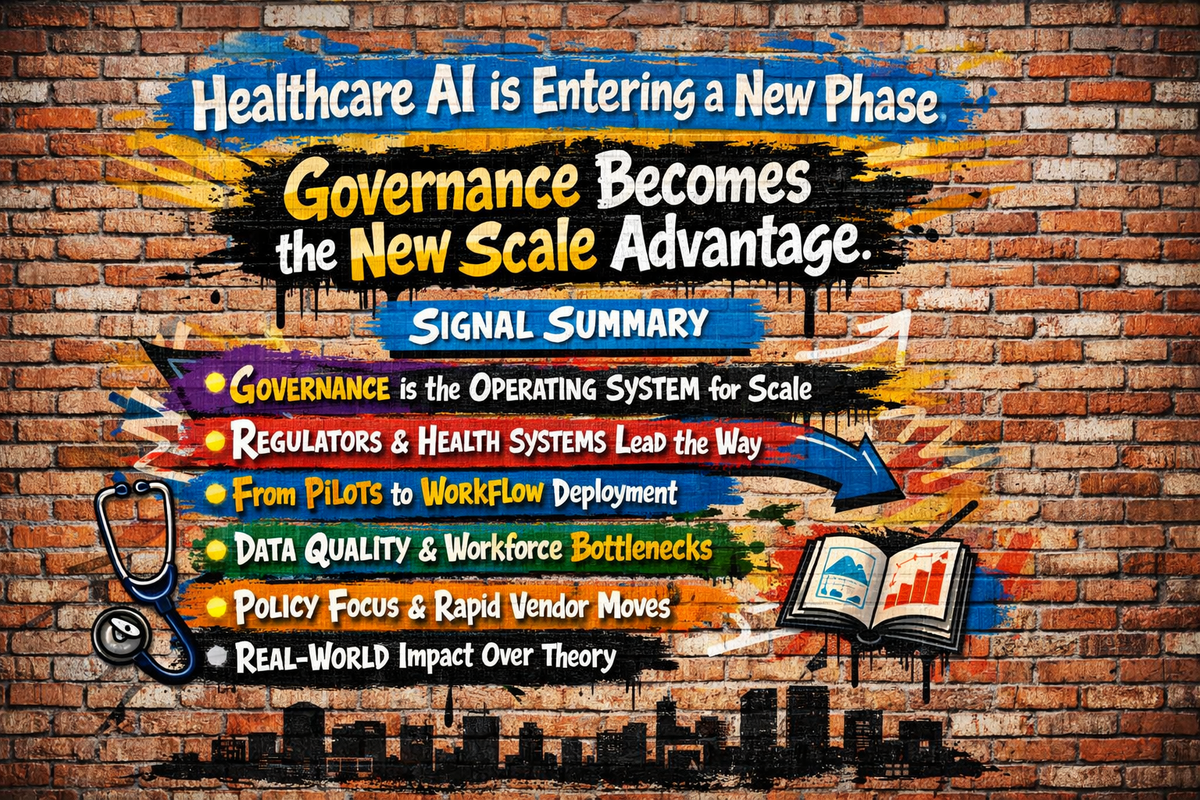
Healthcare AI is Entering a New Phase. Governance Becomes the New Scale Advantage
The biggest signal this week was not another flashy launch. It was the market-wide shift from AI experimentation to governed deployment.
March 17th, 2026
Strategic Exercise for Healthcare Leaders
Copy this newsletter into ChatGPT or Claude along with your 2026 strategy and ask: “Based on these Healthcare AI signals from Gregg Boyle at https://healthcaresignal.ai , is our strategy on track? Where are we aligned, where are we behind, and what tactical actions should we prioritize?” AI will quickly surface gaps, risks, and opportunities in your roadmap.
For a more detailed version of this exercise visit my website.
Signal Summary
- Governance is no longer a side issue. It is becoming the operating system for healthcare AI scale.
- The strongest stories came from regulators and health systems, not from press releases.
- Health systems are moving from isolated pilots to embedded, workflow-level deployment.
- Data quality, clinician evaluation, and workforce literacy are becoming the real bottlenecks.
- Policy attention is rising at the same time vendor launches are accelerating.
- Research keeps moving forward, but most of the durable signal is still operational, not theoretical.
Big Signal of the Week
FDA Signals the Real State of AI in Healthcare: 1,000+ Devices Approved and Growing Fast Signal Score: 9.3 (High Signal)
What Happened The FDA updated its resource on AI-enabled medical devices and signaled greater transparency around devices that use foundation models and LLM-related functionality.
Why It Matters This is the clearest sign of the week that regulators are moving from abstract AI oversight to more specific classification and visibility. That changes the game for vendors, health systems, and investors. When regulators start naming the categories they care about, the market starts reorganizing around those categories.
Strategic Implication Healthcare leaders should expect procurement, risk review, and vendor diligence to get sharper. This pushes AI governance upstream, before deployment, not after an incident.
What Leaders Should Watch Watch for the next layer of specificity around model documentation, post-market monitoring, and how foundation model functionality gets disclosed in clinical and operational products.
Source: FDA
Real World Deployments
Mass General Brigham Signals the Future: AI Is Becoming Core Infrastructure, Not a Pilot Signal Score: 8.8 (High Signal)
What happened: Mass General Brigham laid out an enterprise approach to AI focused on governance, cybersecurity, privacy, and sustainability. Operational impact: This is what mature adoption looks like. AI gets treated like infrastructure, not a side project. Signal takeaway: The winners will operationalize AI with institutional controls, not scattered use cases.
Source: HealthcareIT News
From End Users to Decision Makers: Clinicians Take the Lead on AI Evaluation Signal Score: 8.8 (High Signal)
What happened: Clinicians at Emory Healthcare and Mass General Brigham are being brought into structured evaluation of AI tools before scale. Operational impact: That improves safety, adoption, and workflow fit. Signal takeaway: Clinical governance is becoming a formal capability, not an informal opinion.
Source: Mobile Health News
Healthcare AI Has Entered the Maturity Phase? Leaders Are Now Navigating Scale, Not Pilots Signal Score: 8.6 (High Signal)
What happened: Provider leaders discussed AI maturity, ROI, governance, and hype. Operational impact: This reflects where the market really is. Some use cases are mature, but oversight remains uneven. Signal takeaway: The next gap is not imagination. It is disciplined scaling.
Source: Healthcare IT News
The Next Barrier to AI in Healthcare Isn’t Models, It’s Data Infrastructure Signal Score: 8.6 (High Signal)
What happened: Intermountain Health emphasized standardized data as the foundation for scaled AI. Operational impact: Better data quality means better model performance, lower risk, and more usable workflows. Signal takeaway: Data infrastructure is now strategy.
Hospitals Are Deploying AI Where It Pays First: Operational Efficiency Signal Score: 8.6 (High Signal)
What happened: Hospitals are using AI to reduce administrative burden and reclaim staff time. Operational impact: This is where near-term ROI is showing up. Signal takeaway: Operational AI is beating moonshot AI.
Source: Healthcare Finance News
Market Signals
AI Is Escalating the Payer–Provider Battle Over Payments Signal Score: 8.2
What happened: Reuters mapped the AI arms race between providers and payers around coding and reimbursement. Why it matters: AI is now a margin weapon on both sides of the table. Signal takeaway: Revenue cycle AI is strategic, but it raises scrutiny risk fast.
Source: Reuters
Epic Is Turning AI Into a Buildable Capability. Health Systems Now Need the Talent to Match Signal Score: 8.0
What happened: Epic expanded its AI roadmap and previewed tooling allowing health systems to build and orchestrate agents. Why it matters: When the EHR platform gets deeper into orchestration, it can shape the control plane for enterprise AI. Signal takeaway: The platform fight is shifting from AI features to AI workflow infrastructure. This will change the type of talent health systems must recruit and retain to be successful.
Source: Fierce Healthcare
Policy and Regulation
NSW Health Signals the Next Phase of AI Adoption: Formal Governance at Scale Signal Score: 8.9 (High Signal)
What happened: NSW Health introduced a risk-based AI framework for public hospitals. Executive implication: This is a concrete model for system-wide guardrails. Leaders should study it as a template, not a foreign curiosity.
Source: Healthcare IT News
Washington Is Waking Up to AI in Healthcare. Policy Momentum Is Building Signal Score: 8.5 (High Signal)
What happened: A policy roundup flagged congressional attention on healthcare AI data governance and oversight. Executive implication: Federal scrutiny is broadening. Assume governance questions are moving from advisory to structural.
Source: Society of General Internal Medicine
CMS Is Signaling Support for Agentic AI—And That Changes the Adoption Curve Signal Score: 7.9
What happened: CMS officials framed agentic AI as part of modernization. Executive implication: Policy enthusiasm does not equal policy clarity. Leaders should separate rhetoric from implementation pathways.
Source: Fierce Healthcare
Funding Signals
Nitra Funding Signals a Shift: AI Is Moving Into Managing the Back Office of Clinic-Based Care Signal Score: 7.0
Funding context: Big money is still flowing into administrative infrastructure. Why capital is flowing here: Practice operations remain fragmented, costly, and ripe for automation. Signal takeaway: Investors still believe admin workflows are one of the cleanest healthcare AI monetization paths.
Source: Med City News
AI Is Bringing ‘Moneyball’ to Healthcare, And Changing How Performance Is Measured Signal Score: 7.0
Funding context: The piece points toward value capture in patient identification and care-gap workflows. Why capital is flowing here: Buyers pay for measurable operational lift. Signal takeaway: Capital is favoring use cases that tie directly to economics.
Source: Med City News
Research Finding and Breakthroughs
New Research Signals a Reality Check: AI Performance in Healthcare Still Depends on Real-World Validation Signal Score: 8.3
Key finding: Researchers showed an AI framework that may reduce false alarms while improving mortality prediction. Why it matters: Alert fatigue is a real barrier to useful clinical AI. Signal takeaway: Better signal-to-noise at the bedside is where research becomes deployable.
Source: Nature
New Evidence Shows AI’s Potential and the Barriers to Real-World Adoption Signal Score: 8.3
Key finding: A lightweight chatbot deployed within a hospital improved EHR search and retrieval in a pediatric setting. Why it matters: This is practical research tied to everyday workflow friction. Signal takeaway: Embedded productivity gains matter more than novelty.
Trend to Watch
This week’s dominant theme is simple. Healthcare AI is becoming less about tools and more about operating models.
The strongest signals came from organizations building governance, evaluation, data discipline, and system-wide deployment structures. That matters because it marks a shift in market maturity. The conversation is moving from “what can AI do?” to “what conditions must exist for AI to scale safely and economically?”
The second pattern is that embedded AI is winning. Whether in the EHR, operations, revenue cycle, or device oversight, the center of gravity is moving toward systems that fit existing workflows and are accountable inside them.
The implication is clear. The organizations that win in healthcare AI will not simply be the ones experimenting with the most tools. They will be the ones building the infrastructure to operate AI as a system capability. In the coming year, the real competitive advantage will come from governance, integration, and workflow ownership. AI is moving from innovation project to institutional capability, and the leaders who recognize that shift early will shape how healthcare actually uses it.
Did I miss something or do you see a different perspective? I would love the feedback. Feel free to comment or repost the newsletter adding your own commentary. I look forward to the discussion!
The Signal Top 10 Scoreboard
- Artificial Intelligence-Enabled Medical Devices | 9.3 | Policy | Regulatory specificity is getting real
- NSW Health unveils AI framework for public hospitals | 8.9 | Policy | A real governance blueprint for public systems
- AI, embedded across the enterprise: Valuable perspective from Mass General Brigham | 8.8 | Deployment | Mature enterprise adoption model
- Clinicians take a larger role in evaluating AI tools for healthcare | 8.8 | Deployment | Clinician-led evaluation is becoming standard
- Healthcare leaders navigating a 'very interesting time' for AI maturity | 8.6 | Deployment | AI maturity is now a leadership issue
- Standardized data critical to scaling AI, healthcare benefits | 8.6 | Deployment | Data quality is now a scaling constraint
- AI gains traction as hospitals focus on operational efficiency | 8.6 | Deployment | Near-term ROI is operational
- Health Policy News: March 16, 2026 | 8.5 | Policy | Congressional oversight is rising
- AI-powered Chatbot integration for enhanced accessibility of electronic health records in a pediatric hospital | 8.3 | Research | EHR workflow research is getting practical
- Artificial Intelligence-powered tiered early warning framework addressing high false alarm rates for in-hospital mortality prediction | 8.3 | Research | Better alerts mean more usable clinical AI
This Weeks AI Market Tracker
- Health system deployments this week: 10
- Vendor announcements: 23
- Policy developments: 7
- Funding announcements: 7
- Research breakthroughs: 9
Summary of Market Announcements Reviewed
- Total articles I reviewed: 92
- High signal stories I identified: 18
- Emerging signal stories: 52
- Noise stories filtered: 22 Your welcome! :)