
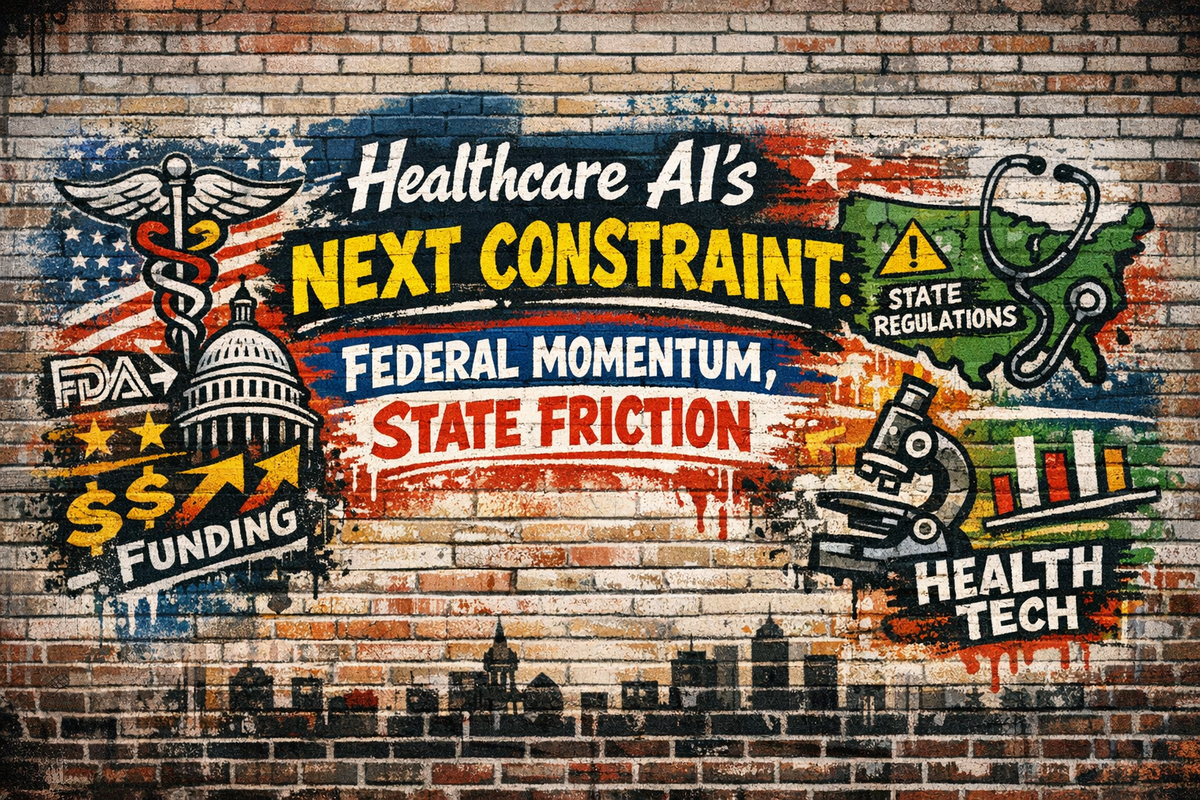
Healthcare AI’s Next Constraint: Federal Momentum, State Friction
March 24th, 2026
Healthcare AI is still deep in its announcement era. Every week brings more copilots, agents, platforms, studies, and funding rounds. But the real challenge for healthcare leaders is not keeping up with the volume. It is identifying which developments actually change how healthcare can operate.
Strategic Exercise for Healthcare Leaders
Copy this newsletter into ChatGPT or Claude along with your 2026 strategy and ask: “Based on these Healthcare AI signals from Gregg Boyle at healthcaresignal.ai, where are we aligned, where are we exposed, and what should we prioritize next?”
That should surface whether your roadmap is built for the healthcare AI market that is actually forming, not the one vendors are pitching.
This Weeks Signal Summary
This week’s signal is that the next constraint on AI adoption may not be the technology itself. It may be the policy environment around it. Federal leaders are signaling simplification and scale, states are tightening scrutiny in higher-risk workflows, and regulators like FDA are becoming more concrete in specific clinical categories. That creates a more uneven market where some AI use cases may move faster than others. Not because they are better, but because they face less friction.
The takeaway is straightforward: the winners in healthcare AI may not be the loudest companies or the ones with the most announcements. They may be the organizations operating in workflows with the clearest approval pathways, the least fragmented policy exposure, and the most immediate operational value. This week’s issue looks at where that shift is starting to show up across policy, deployment, and research.
Big Signal of the Week
White House Framework Seeks Federal AI Preemption, Streamlining Healthcare Deployments
View Briefing - Signal Score: 8.2
What happened The White House published a national AI legislative framework calling for a single federal standard for AI, including federal preemption of state AI laws and regulatory sandboxes. In practical terms, it signals a push toward less fragmented AI governance across industries, including healthcare.
Why it matters This is not just another policy announcement. It suggests that federal leaders see state-by-state AI rules as a barrier to scale. For healthcare, that could materially affect how vendors, health systems, and investors think about compliance, product rollout, and interstate deployment.
Strategic implication If this direction gains traction, the market may begin favoring AI products and strategies built for national scale rather than local regulatory variation.
What leaders should watch Watch for congressional action, HHS or FDA follow-through, and whether healthcare-specific language emerges that clarifies how much real simplification this framework would create.
Source Axios / White House
Policy and Regulation
States Push AI Guardrails in Insurance and Mental Health, Signaling Fragmentation in High-Risk Workflows
View Briefing - Signal Score: 8.0
What happened While federal leaders are signaling simplification, states are moving in the opposite direction in some of the most sensitive healthcare workflows. The dataset flags state action around AI-only insurance decisions, mental-health chatbot oversight, and disclosure requirements.
Why it matters This is the other side of the market. Even as federal policy points toward scale, states are starting to tighten restrictions where patient safety, denial risk, or behavioral-health vulnerability are most visible.
Strategic implication The near-term healthcare AI market may become uneven. Administrative and lower-risk augmentation tools may move faster, while payer-facing, behavioral-health, and autonomous decision workflows may encounter more friction.
What leaders should watch Watch for more state bills targeting insurance determinations, patient-facing chatbots, and other workflows where AI is perceived as replacing judgment rather than supporting it.
Source Transparency Coalition
FDA Approves First AI Device for Real-Time Breast Cancer Margin Assessment in Surgery
View Briefing - Signal Score: 8.0
What happened Perimeter Medical received FDA approval for Claire, the first AI-enabled device cleared in the U.S. to assess breast cancer margins during surgery. The approval includes a predetermined change control plan for future AI updates.
Why it matters This is a more useful policy signal than generic AI oversight rhetoric because it shows one area where regulation is becoming more operationally specific. The FDA is not just reviewing AI in theory. It is creating a practical path for regulated, updatable AI in a real clinical workflow.
Strategic implication Some AI categories may gain clearer deployment pathways even while the broader policy environment gets more fragmented. That creates a market where regulated precision tools could move faster than loosely governed general-purpose systems.
What leaders should watch Look for named health system deployments, outcome data, and future FDA signals around how adaptive AI updates are documented and monitored post-approval.
Source CEO Magazine
Deployment
Doximity Survey Signals AI Is Becoming a Routine Workflow Tool for Physicians
View Briefing - Signal Score: 7.0
What happened Doximity’s 2026 physician survey of 3,151 physicians found that 94% are either using AI or interested in it, and 54% report current use. The most common use cases were literature search, voice documentation, drafting letters, prior authorization workflows, and summarizing records. Reported benefits included lower administrative burden, less after-hours work, and more time for patient care.
Why it matters This works well as this week’s deployment signal because it does not repeat last week’s “enterprise maturity” stories from Mass General Brigham, Emory, and Intermountain. Instead, it shows what deployment looks like on the ground: AI is becoming routine in narrow, useful tasks that reduce friction for clinicians.
Strategic implication The real deployment story remains practical, not futuristic. AI is winning first where it helps clinicians document faster, search faster, and spend less time on low-value administrative work.
What leaders should watch Watch for independently verified results from named health systems showing sustained reductions in documentation time, burnout, and after-hours workload, not just positive survey sentiment.
Source Doximity
Research Finding and Breakthrough
AI in Oral Cancer Screening Moves Closer to Lightweight, Workflow-Ready Models
View Briefing - Signal Score: 7.8
What happened A review in Frontiers in Oncology highlights oral cancer screening models evolving toward lighter architectures that may be better suited for real-time clinical use, with some studies reporting AUC above 95%.
Why it matters This is worth including not because it proves immediate deployment, but because it reflects a more useful research pattern: models getting smaller, more targeted, and closer to practical screening workflows instead of staying trapped in generalized AI hype.
Strategic implication The research most likely to matter commercially may be research that simplifies deployment, not research that simply maximizes model ambition.
What leaders should watch Look for named pilots, multi-center validation, and evidence that these lightweight models can fit real preventive care and screening workflows without requiring heavyweight infrastructure.
Source Frontiers in Oncology
Trend to Watch
This week’s dominant theme is not just that healthcare AI needs governance. It is that healthcare AI is entering a more uneven policy environment. Federal leaders are signaling scale. States are tightening scrutiny in higher-risk use cases. Regulators like FDA are becoming more concrete in specific categories.
That means the next healthcare AI winners may not simply be the companies with the best models or the most announcements. They may be the ones operating in workflows with the clearest approval pathways, the least fragmented policy exposure, and the most immediate operational value.
The market is still full of copilots, assistants, agents, and platforms. But the signal this week is that scale is starting to depend less on how exciting the product sounds and more on how cleanly it fits into the emerging policy map.
The Signal Top 10 Scoreboard
- White House Framework Seeks Federal AI Preemption, Streamlining Healthcare Deployments | 8.2 | Policy | Federal simplification could become a real scale advantage
- AI Drives Proven ROI in Utilization Management, Signaling Scalable Admin Efficiency Gains | 8.2 | Deployment | Administrative AI is proving its value where ROI is easiest to measure
- AMIE’s Clinical Study Signals Conversational AI Nearing Diagnostic Workflow Readiness | 8.2 | Research | Conversational clinical AI is edging closer to real workflow relevance
- FDA Approves First AI Device for Real-Time Breast Cancer Margin Assessment in Surgery | 8.0 | Policy | Adaptive clinical AI is starting to get clearer regulatory pathways
- States Push AI Guardrails in Insurance and Mental Health, Signaling Fragmented Regulation Ahead | 8.0 | Policy | State friction is forming first in high-risk healthcare workflows
- Verily’s $300M Raise Signals Precision Health AI Maturing Beyond Big Tech Control | 8.0 | Funding | Investors still see durable upside in scaled precision-health platforms
- UCSD Health Reveals Practical Strategies for Scaling AI in Patient Outreach and Workflows | 8.0 | Deployment | Real deployment now looks like workflow design, not isolated pilots
- AI in Oral Cancer Screening Advances to Lightweight Models for Real-Time Clinical Use | 7.8 | Research | More deployable screening AI is emerging through smaller models
- ARPA-H Pushes for Clinically Tested, FDA-Authorized AI Agents in Healthcare | 7.8 | Policy | The federal bar is rising from interest in AI to validated clinical usefulness
- AI as “Autopilot” Poses Clinician Deskilling Risks, Calling for Co-Intelligent Training Models | 7.5 | Frontier | The next AI implementation problem may be workforce adaptation
This Week’s AI Market Tracker
- Health system deployments this week: 8
- Vendor announcements: 12
- Policy developments: 12
- Funding announcements: 7
- Research breakthroughs: 9