
The Agent Threshold: AI Is No Longer Assisting... It's Acting
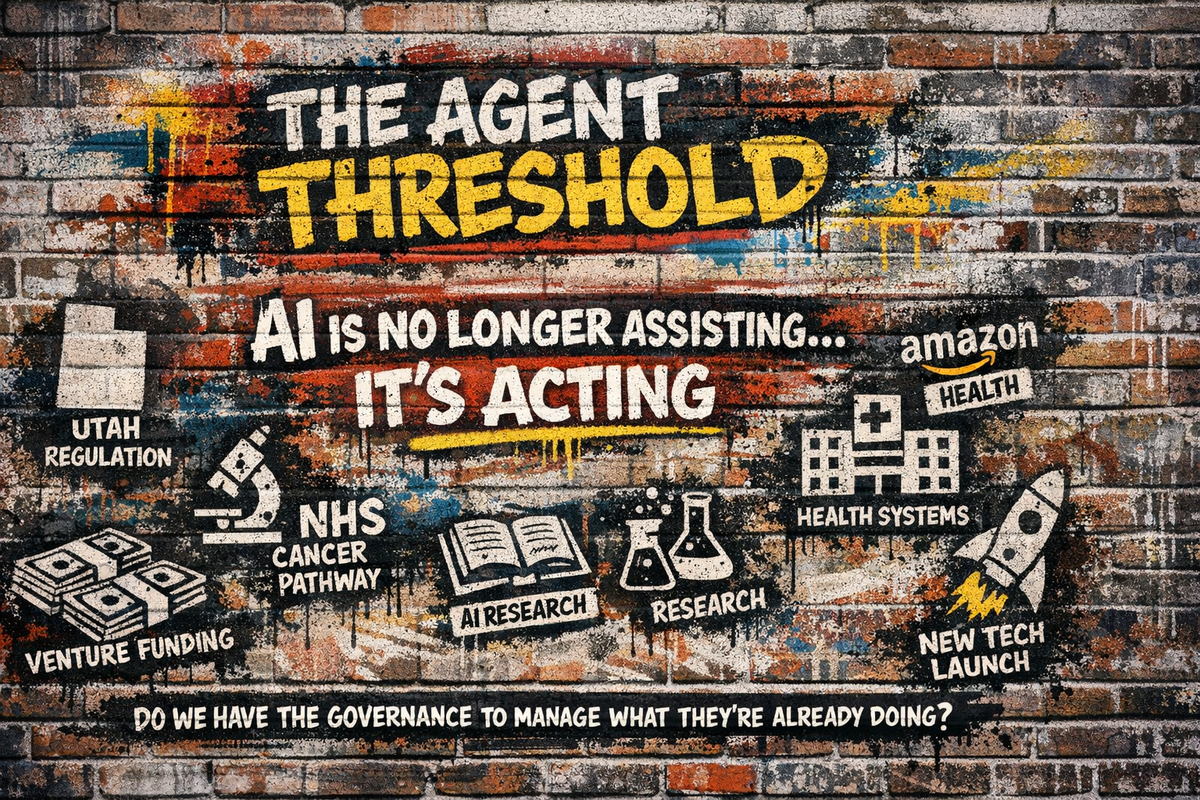
AI agents aren't waiting for permission anymore. They're coordinating cancer pathways, renewing prescriptions, and routing patients through Amazon's app. This week's signals reveal where the real infrastructure of healthcare AI is being built — and by whom. The leaders gaining ground aren't the ones still asking whether to move. They're the ones who already know which direction they're going.
Utah Becomes the First State to Authorize AI to Autonomously Renew Prescriptions and Doctronic Just Raised $40M to Scale It
🔴 MAJOR SIGNAL | SCORE: 8.2 | View Article
WHY IT MATTERS
For the first time in U.S. history, an AI system has been legally authorized to perform an autonomous clinical act — renewing prescriptions — without a physician in the loop for routine cases. This isn't a pilot or a proof of concept. It's a functioning regulatory pathway, built through state-level sandbox experimentation, that just attracted $40M in institutional capital. Every health system leader should understand both what it enables and where the edges of that authorization actually are.
KEY DETAILS
- Organizations: Doctronic, Utah Office of AI Policy, Abstract and Lightspeed Venture Partners
- Technology: Autonomous prescription renewal AI operating 24/7 across 190 medications, with automatic escalation for complex cases
- Scale: $40M Series B, $65M total raised; operating under Utah's AI Learning Lab regulatory sandbox
- Notable Metric: First AI system in U.S. history legally authorized for autonomous prescription action
WHAT THIS SIGNALS
State-level regulatory sandboxes are becoming the proving ground for clinical AI autonomy. Utah didn't wait for federal guidance — it built a framework, attracted a company, and validated a model other states will now either adopt or push back against. The sandbox approach is the pattern worth watching. It's how clinical AI autonomy gets legitimized in the U.S., one state at a time.
My Take: The $40M raise gets the headline. The real story is the regulatory model. Utah's sandbox didn't require federal permission — it created a state-level proof of concept that investors could bet on before national policy caught up. That's the blueprint other states are now looking at, and it's moving faster than most leaders realize. Watch which state files a similar framework next. That's where the next Doctronic is already talking to regulators.
SOURCE: MEDCITY NEWS · BUSINESS WIRE
Philadelphia's Temple, Penn, Jefferson, and CHOP Are All Running Generative AI in Live Clinical Workflows. Digital Twins Are Next.
🔴 MAJOR SIGNAL | SCORE: 8.2 | View Article
WHY IT MATTERS
When four major health systems in a single metro are simultaneously running generative AI in live workflows — ambient listening, clinical documentation, diagnostic support — it marks something real: the pilot era at large academic medical centers is over. What makes this story more than a deployment update is the signal buried inside it. CHOP is building digital twin models that simulate patients for risk prediction. That's a different category of capability entirely.
KEY DETAILS
- Organizations: Temple Health, Penn Medicine, Jefferson Health, Children's Hospital of Philadelphia (CHOP)
- Technology: Generative AI for documentation, diagnostic support in radiology and oncology, ambient listening; emerging digital twin models for patient risk simulation
- Scale: Multi-system operational deployment across a single major market; CHOP building a dedicated AI Research Division
- Notable Metric: All four systems are past pilot stage and in active deployment
WHAT THIS SIGNALS
Large academic health systems are no longer managing the question of whether to deploy AI — they're managing what comes after the first wave. The digital twin development at CHOP is the leading edge of that next wave: patient-level simulation for risk modeling, predicting deterioration before it becomes a crisis. Philadelphia is showing the country what Year Two of health system AI actually looks like.
My Take: Four competing health systems in the same city are all running live AI simultaneously, and none of them announced it as a competitive differentiator. They announced it as infrastructure. That framing shift is the real signal. When health system leaders stop positioning AI as an advantage and start treating it as a baseline, the conversation about what actually differentiates care gets more interesting, and more urgent.
SOURCE: TECHNICAL.LY
Amazon Launches Health AI With Cleveland Clinic and Rush University as Partners — Redefining Where the Patient Journey Begins
🟡 REAL-WORLD DEPLOYMENT | SCORE: 7.0 | View Article
WHY IT MATTERS
Amazon's Health AI integrates lab result interpretation, personalized health guidance, and direct connection to One Medical clinicians — all from inside the consumer Amazon experience. With Cleveland Clinic and Rush University as named partners, this is no longer a tech company testing the edges of healthcare. It's a clinical distribution strategy operating at a scale most health systems can't match.
KEY DETAILS
- Organizations: Amazon, Amazon One Medical, Cleveland Clinic, Rush University System for Health
- Technology: AI-powered health assistant in the Amazon app; integrates personalized medical data via secure exchange; connects to clinical teams
- Scale: Amazon ecosystem reaches hundreds of millions of consumers; One Medical provides the clinical backstop
- Notable Metric: First Amazon-scale bridge between a consumer commerce platform and clinical records
WHAT THIS SIGNALS
The front door of healthcare is moving. Patients are increasingly starting their health journey inside consumer platforms — searching symptoms, interpreting labs, deciding whether to call a doctor — long before they touch a health system's digital front door. The health systems with named Amazon partnerships are in that conversation. The ones without a strategy for meeting patients where they already spend time are watching from the outside.
My Take: Cleveland Clinic and Rush didn't just partner with Amazon, they handed Amazon a clinical credibility layer that makes its health product trustworthy to consumers. In exchange, Amazon gave them distribution no health system marketing budget could buy. That's not a technology partnership. That's a patient acquisition strategy dressed in the language of innovation. The question for every other health system isn't whether to build an app, it's whether they have a partner with Amazon's reach, or a plan to build one.
SOURCE: FOX NEWS TECH
AI Agents Go Live in NHS Cancer Pathways — and the Field Is Already Identifying Its Own Vulnerabilities
🟡 REAL-WORLD DEPLOYMENT | SCORE: 7.8 | View Article
WHY IT MATTERS
OpenClaw is deployed at Guy's and St Thomas NHS Foundation Trust to coordinate lung cancer pathways — integrating with EHRs and clinical hardware in a live environment. This is one of the most concrete examples anywhere of an AI agent managing multi-step care coordination, not just generating documentation. Running in parallel: the identification of command-execution and credential-leak risks in agentic frameworks. That second story isn't a warning against deployment — it's a sign the field is maturing fast enough to find and name its own failure modes.
KEY DETAILS
- Organizations: OpenClaw, Guy's and St Thomas NHS Foundation Trust, NVIDIA (NemoClaw security framework)
- Technology: AI agents coordinating lung cancer care pathways, integrating EHRs and clinical hardware; NVIDIA's NemoClaw framework addresses emerging security risks in agent architectures
- Scale: Live deployment at one of the UK's largest NHS trusts; security vulnerabilities documented in parallel by a major infrastructure vendor
- Notable Metric: Named, active deployment in cancer care coordination — among the highest-stakes clinical contexts
WHAT THIS SIGNALS
The complexity ceiling for clinical AI agents is rising fast — and the industry is developing the security frameworks to match. The fact that NVIDIA is building NemoClaw in response to real vulnerabilities found in live deployments is how mature infrastructure gets built. Leaders watching this story should track both trajectories: where agents are being trusted with high-stakes workflows, and how the security architecture around them is taking shape.
My Take: The cybersecurity findings aren't the concerning part of this story, they're the encouraging part. NVIDIA building NemoClaw in direct response to live deployment vulnerabilities means the security layer is developing alongside the deployment layer, not years behind it. That's what a maturing infrastructure looks like from the inside. The NHS didn't slow down to wait for perfect security. It deployed, found the edges, and the ecosystem responded. That sequence is how trust in clinical AI actually gets built.
SOURCE: MAYO CLINIC PLATFORM
CMS Declares an AI "Cultural Shift" in Medicaid and Launches a Medicare App Library
🔴 POLICY & REGULATION | SCORE: 8.2 | View Article
WHY IT MATTERS
Federal agencies don't use the phrase "cultural shift" casually. CMS framing AI in Medicaid as a strategic cultural priority — paired with a new Medicare App Library designed to vet and distribute AI-powered tools — signals something meaningful: the largest payer in the U.S. has moved from tolerating AI to actively promoting it. The procurement and compliance implications will move through the entire provider and vendor ecosystem.
KEY DETAILS
- Organizations: CMS, AHIP
- Technology: AI for Medicaid fraud detection, cost reduction, and simplified patient experience; Medicare App Library for AI tool vetting and distribution
- Scale: Federal Medicaid and Medicare programs covering over 150 million beneficiaries across all 50 states
- Notable Metric: First explicit federal framing of AI in public payer programs as a strategic cultural priority
WHAT THIS SIGNALS
When CMS puts its institutional weight behind AI, it reshapes the market. The Medicare App Library may quietly become the de facto AI clearinghouse for government-adjacent healthcare — a gatekeeper role with enormous influence over which tools get adopted at scale. Vendors aligned with CMS priorities have a new distribution channel forming. Providers not yet tracking the App Library's evolution will want to start.
My Take: The Medicare App Library is getting less attention than the "cultural shift" language. and that's backwards. A federal vetting and distribution mechanism for AI tools is a gatekeeper with enormous downstream power. Whatever criteria CMS uses to approve tools for that library will quietly shape which AI products get adopted across 150 million beneficiary relationships. That's not a compliance story. That's a market structure story, and it's being written right now.
SOURCE: POLITICO
Qualified Health Raises $125M Series B With Mercy and Emory on Board — Enterprise Platform Consolidation Is Accelerating
🟡 FUNDING SIGNAL | SCORE: 7.2 | View Article
WHY IT MATTERS
A $125M Series B with flagship health system partners and NEA leading is a clear market signal: large health systems are choosing enterprise AI platforms over assembling point solutions. The speed and scale of this round — and the caliber of named adopters — suggests market consolidation is arriving earlier than most vendors built their roadmaps to expect.
KEY DETAILS
- Organizations: Qualified Health, New Enterprise Associates (lead), Mercy, Emory Healthcare
- Technology: Secure enterprise AI transformation platform for health systems; 500,000+ users
- Scale: $125M Series B; named partners among the largest health systems in the U.S.
- Notable Metric: Round size and partner depth suggest the platform tier is separating from the point-solution tier
WHAT THIS SIGNALS
Institutional capital is concentrating around enterprise platforms with proven health system relationships — and it's moving faster than the conventional wisdom predicted. The bifurcation between platform players and point solutions is no longer theoretical. Health system leaders evaluating AI vendors should be asking not just what a solution does today, but where it sits in a consolidating market two years from now.
My Take: Mercy and Emory aren't just customers in this deal, they're validators. When health systems of that scale attach their names to a Series B, they're signaling to every other health system CIO that the evaluation work has been done. That's a different kind of endorsement than a case study or a reference call. It's a market signal embedded inside a funding announcement, and the vendors watching this round know exactly what it means for their own positioning.
SOURCE: PRNEWSWIRE
Health Affairs Scholar Proposes AI Enables a New "Generalist-Specialist" Clinician Model — and It Requires Rewiring How Medicine Is Trained and Paid
🟡 RESEARCH BREAKTHROUGH | SCORE: 7.5 | View Article
WHY IT MATTERS
This paper, published in a peer-reviewed journal, makes a structural argument that goes well beyond efficiency: AI may enable clinicians to practice across disease domains simultaneously — functioning as both generalist and specialist — reducing handoffs and fundamentally changing how care is organized. The downstream implications touch medical education, credentialing bodies, and CMS payment structures. That combination of peer-reviewed backing and systemic scope gives this real policy weight.
KEY DETAILS
- Organizations: Health Affairs Scholar (publication)
- Technology: AI augmentation enabling expanded clinician scope across disease domains
- Scale: Conceptual but peer-reviewed; implications reach every physician training pathway and specialty credentialing board in the U.S.
- Notable Metric: Identifies three systemic changes required — medical education reform, credentialing restructure, and CMS payment model adjustment
WHAT THIS SIGNALS
This is the first credible academic framing of AI not as a productivity tool, but as a structural enabler of a different kind of clinical workforce. If the model takes hold, it reshapes how health systems staff, how physicians train, and how CMS defines billable care. Leaders thinking about AI only through the lens of efficiency may be solving for the wrong variable entirely.
My Take: The paper identifies three systems that have to change for this model to work: medical education, credentialing, and CMS payment. Those three systems are each controlled by different institutions with different incentives and different timelines. The research is ahead of the infrastructure, which is exactly where the most important ideas tend to appear first. The question isn't whether this model is theoretically sound. It's which of those three systems moves first, and what it unlocks when it does.
SOURCE: HEALTH AFFAIRS SCHOLAR
Closing Thought
"The infrastructure is being built whether or not the playbooks exist yet. The leaders who understand the architecture will write the playbooks."
A Note Before You Close This
The signals in this issue describe a market that is moving faster than most 2026 roadmaps were written to anticipate. Before your next leadership meeting, put this briefing next to your current AI strategy and ask three questions:
Where are we already aligned with what's forming? Where are we assuming a version of this market that no longer exists? What would we have to decide differently if we took these signals seriously?
You don't need a new tool to answer those questions. You need honest eyes on the gap between where the infrastructure is being built and where your plan assumes it will be.
That gap is what this briefing exists to make visible.