
The Carrot and the Stick Arrived Together
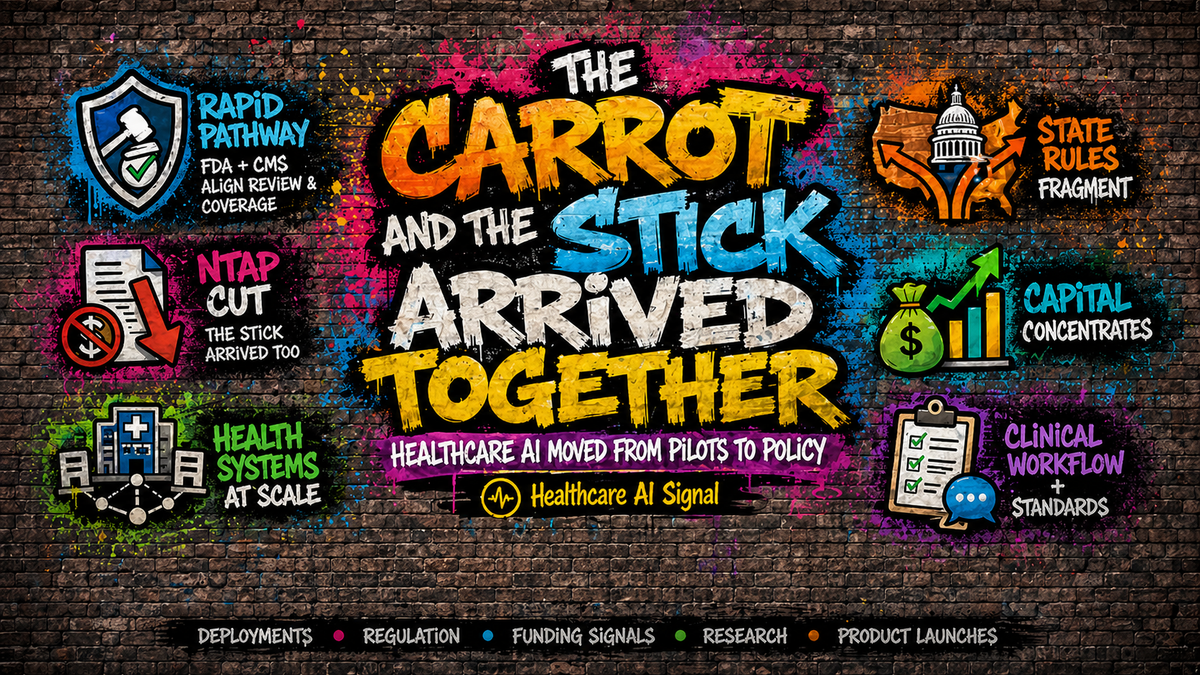
While many still chased ambient AI headlines, the FDA, CMS, and a half-dozen state regulators continued to write the rules that determine which AI gets paid for, which gets enforced against, and which gets pulled.
Procurement committees will now have a different rubric to use. Health systems already operating at scale are separating from those still evaluating. The pre-2026 era ran on pilots and press releases. This week, the regulated era began.
1. Signal Summary
- Big Signal: FDA and CMS launched the RAPID coverage pathway on April 23, aligning premarket review with Medicare coverage decisions for breakthrough devices. The biggest regulatory accelerant for AI-enabled medical devices in years.
- The same week, CMS proposed killing the Breakthrough Device NTAP fast-track in its FY2027 IPPS rule. The carrot and the stick arrived in the same news cycle.
- Five health systems published evidence of operational AI including Kaiser Permanente, Phoenix Children's, UCHealth, Walter Reed/DHA, and HonorHealth collectively moving them past the pilot conversation entirely.
- State-level AI governance fragmented further, with new insurance-AI laws in Pennsylvania, New Hampshire, Oklahoma, Indiana, Louisiana, and Alabama, plus Utah's medical board demanding a halt to the state's own autonomous prescribing pilot.
- Capital concentrated at the top. UnitedHealth committed $1.5B to AI, Merck signed a multi-year deal with Google Cloud reportedly worth up to $1B, and Q1 2026 digital health funding hit $7.4B with eight new unicorns.
- OpenAI launched a free clinician workspace, signaling foundation model providers' direct entry into the clinical workflow market.
- CARF International issued the first AI accreditation standard for health and human services, requiring documented written policies on AI use, oversight, and accountability.
2. Big Signal of the Week
FDA-CMS RAPID Pathway Accelerates Medicare Coverage for Breakthrough Devices
🔴 Major Signal | Score: 9.0 (High Signal) | View Article
Why It Matters
The Medicare coverage gap has been the structural ceiling on AI-enabled device adoption. A device gets cleared, then waits 12–24 months for a coverage determination, during which the manufacturer burns capital and health systems hold back from procurement. RAPID compresses that timeline materially. For AI vendors with breakthrough-eligible products, the math on time-to-revenue just changed.
Key Details
- Agencies: FDA and CMS, joint announcement
- Date: April 23, 2026
- Pathway: Regulatory Alignment for Predictable and Immediate Device (RAPID)
- Scope: FDA-designated Class II and Class III Breakthrough Devices
- Mechanism: Aligns FDA premarket review with CMS coverage expectations earlier in the development cycle
- Companion action: CMS proposed eliminating the alternative NTAP fast-track pathway for FY2028 in the same week's FY2027 IPPS rule (Score: 8.2)
- Historical baseline: 12–24 months from FDA clearance to Medicare coverage determination
What This Signals
Two things follow. First, the breakthrough device designation becomes more valuable than it was a week ago, which will pull more AI vendors toward that pathway. Second, every CFO and capital planner in a health system needs to revise the assumption that breakthrough AI devices are still 24 months from reimbursement.
My Read: The pairing is the story most coverage missed. RAPID and the NTAP elimination proposal arrived in the same news cycle, and they're not contradictions, they're the two sides of the same regulatory thesis. The agencies are saying: if your evidence is strong enough to clear breakthrough status, you'll get to revenue faster. If it isn't, the alternative pathways are closing. CFOs and capital allocators evaluating breakthrough-eligible AI vendors should re-rate them this quarter. Vendors still chasing NTAP without breakthrough designation are walking into a narrowing window. The bigger structural shift is that "real-world evidence" RWE has now been operationalized as the differentiator regulators reward, turning what was a marketing slide into a procurement criterion. So RAPID isn't just a market signal, it's a directive to stand up an internal RWE function this quarter, because the AI partners worth keeping will increasingly co-author evidence with their customers, not just deliver it to them.
Source: U.S. Food and Drug Administration
3. Real-World Deployments
Kaiser Permanente's AI Navigator Hits 97%+ Triage Accuracy at Scale
🔴 Real-World Deployment | Score: 8.5 (High Signal) | View Article
Why It Matters
Patient triage is the front door of every health system's cost structure, and Kaiser is now running it through AI before a clinical encounter is scheduled. KPIN, Kaiser Permanente Intelligent Navigator, operates at scale across Southern California Permanente Medical Group with reported high-risk symptom detection accuracy above 97%. This is the most consequential value-based-care AI deployment of the week.
Key Details
- Organization: Southern California Permanente Medical Group / Kaiser Permanente
- Tool: Kaiser Permanente Intelligent Navigator (KPIN)
- Technology: Natural language processing AI embedded in the patient portal
- Capability: Patients describe needs in their own words; AI detects high-risk symptoms and routes them appropriately
- Reported accuracy: >97% for high-risk symptom detection
- Operating model: Integrated payer-provider, value-based architecture
What This Signals
KPIN works because Kaiser's value-based architecture rewards triage accuracy. The integrated payer-provider model absorbs the upstream investment because it captures the downstream avoided cost. Fee-for-service systems will struggle to replicate the unit economics, even with the same model.
My Read: Coverage of KPIN focused on the 97% accuracy. The structural signal is the operating model. KPIN works because Kaiser captures the downstream avoided cost of better triage inside its own integrated economics. A fee-for-service health system attempting to replicate the same tool would absorb the upstream investment without capturing the savings, which is why most patient portal AI in non-integrated systems stalls at the demo phase. Boards looking at KPIN as a procurement target should first ask what their organization's economic model rewards. KPIN isn't just an AI deployment; it's an artifact of value-based care. That's both why it works and why it's hard to copy. The harder question KPIN raises isn't 'can we copy it', it's 'do we have an autonomous patient-facing AI governance framework, and if not, when?'
Source: American Medical Association
Phoenix Children's EHR Dashboard Reduces Post-Cardiac-Arrest Mortality
🔴 Real-World Deployment | Score: 8.5 (High Signal) | View Article
Why It Matters
Mortality is the highest-stakes outcome metric available, and Phoenix Children's reported gains on it from a tool they built themselves. The dashboard is an internally constructed EHR-backed workflow with daily alerts, not a vendor product. The signal is dual: a real outcome at a named pediatric system, and a credible build-versus-buy alternative for systems with the data engineering capacity.
Key Details
- Organization: Phoenix Children's
- Tool: Internally built EHR-backed dashboard with daily alert workflow
- Use case: Pediatric post-cardiac-arrest care
- Workflow: Pulls data across multiple EHR sources, triggers morning review emails and follow-up huddles
- Outcomes: Improved adherence to temperature management protocols and reported mortality gains
- Build vs. buy: Internally developed; IP and workflow stay with Phoenix Children's
What This Signals
Internally developed clinical AI is reemerging as a strategic option for systems with the data engineering capacity to build it. The build-versus-buy calculus on EHR-integrated dashboards has shifted.
My Read: The mortality outcome is what gets noticed; the build decision is what should. Phoenix Children's didn't license a vendor product, they used in-house data engineering to construct the dashboard against their own EHR. Using a standard framework of build candidates (narrow, well-bounded, owns the data, predictable workflow) vs buy candidates (broad, cross-functional, requires deep domain ML expertise the org lacks). So that decision now has compounding implications. The IP stays. The recurring license cost doesn't materialize. The dashboard evolves with the clinical workflow rather than against a vendor roadmap. For systems with comparable informatics capacity, this is a credible alternative to the default "find a vendor" procurement reflex. For vendors selling narrow, well-bounded clinical AI, Phoenix Children's is a competitive variable. The build-versus-buy conversation just got harder for vendor sales teams.
Source: Healthcare IT News
UCHealth Scales AI-Enhanced Virtual ICU Across All 15 Hospitals
🔴 Real-World Deployment | Score: 8.0 | View Article
Why It Matters
System-wide deployment is the boundary most ambient and clinical AI never crosses. UCHealth's nursing command center, augmented by AI flagging deterioration and sepsis, is now operational across the entire 15-hospital system. Experienced virtual ICU nurses use the platform to mentor bedside nurses remotely, workforce multiplication, not replacement.
Key Details
- Organization: UCHealth
- Tool: AI-augmented virtual ICU command center
- Capability: AI flagging patient deterioration and sepsis
- Scale: All 15 hospitals in the system
- Operating model: Virtual ICU nurses mentor less-experienced bedside nurses through the AI-supported platform
- Workforce angle: Addresses nursing shortage by extending experienced clinical judgment
What This Signals
The scale decision matters more than the technology. UCHealth pushed past pilot evaluation across the entire system, which is the boundary most ambient AI deployments never cross. AI-augmented expertise distribution is now a workforce strategy, not just an efficiency tool.
My Read: Pilots end. System-wide deployments are commitments. UCHealth scaled the AI-augmented virtual ICU across all 15 hospitals, past the boundary where most ambient AI deployments quietly stall. The mentoring layer is the underrated detail: experienced virtual ICU nurses use the AI as a force multiplier to extend their judgment to less-experienced bedside nurses. That's not AI replacing clinicians; it's AI replicating expertise. For health systems facing nursing shortages, the model is portable. For workforce strategists, the precedent is significant. Workforce-shortage solutions can now include AI-augmented expertise distribution, not just hiring. The underrated lesson is that UCHealth's scale decision presumed a change management capability most AI organizations are still building. The pilot-to-production transition is a capability gap, not a vendor selection question.
Source: Healthcare IT News (HIMSS TV)
Defense Health Agency Deploys Ambient AI Scribe Across the Military Health System
🔴 Real-World Deployment | Score: 8.2 | View Article
Why It Matters
Federal procurement at scale moves the credibility tier of an entire AI category. DHA is rolling ambient listening AI scribes into the Military Health System with GENESIS EHR integration. This is government-scale validation of ambient AI as operational infrastructure, not pilot technology.
Key Details
- Organization: Defense Health Agency
- Source: Walter Reed National Military Medical Center
- Technology: Ambient listening AI scribe
- EHR integration: GENESIS
- Scope: Military Health System
What This Signals
The federal validation cycle has been the missing piece for ambient AI adoption in adjacent regulated environments. DHA's deployment provides a procurement precedent that VA, federally qualified health centers, and other public-sector buyers can reference.
My Read: The Military Health System procurement matters more than its scale suggests. Federal regulated environments have been slower than civilian academic centers to deploy ambient AI, and DHA's rollout breaks that pattern. The downstream signal is procurement velocity in the VA, FQHCs, and other federal-adjacent contexts that wait for federal validation before moving. Vendors with strong DHA references will have a structural advantage in those follow-on procurements over the next 18 months. Civilian health systems should also note the GENESIS integration, federal procurement increasingly requires deep EHR integration, and the bar that DHA sets for that integration will pressure civilian-side procurement standards. My take is that DHA references should now be a tiebreaker in ambient AI vendor selection, and a signal that integration depth, not feature parity, will dominate the next procurement cycle.
Source: Walter Reed National Military Medical Center
HonorHealth Deploys Abridge to 500 Clinicians Without an Extended Pilot
🔴 Real-World Deployment | Score: 8.0 | View Article
Why It Matters
The wave methodology is what's new here. HonorHealth's CMIO described an enterprise rollout of Abridge across 500 clinicians starting January 2026, structured as cohorts rather than a multi-year pilot. Vendor selection was anchored on KLAS scoring and reference customers, not extended in-house validation.
Key Details
- Organization: HonorHealth
- Vendor: Abridge
- Scale: 500 clinicians (ambulatory and inpatient)
- Rollout start: January 2026
- Methodology: Wave-based enterprise rollout (cohorts tracked clinician-by-clinician)
- Vendor selection anchor: KLAS scoring and reference customer evaluation
What This Signals
Ambient AI is leaving the pilot era for buyers with high vendor confidence. The competitive question for vendors is now reference quality, not pilot success rate. The competitive question for health system buyers is whether their procurement and change-management functions are mature enough to skip the pilot phase.
My Read: The wave methodology is the operational template most ambient AI deployments lack. Pilot-to-production transitions stall when organizations confuse "evaluation" with "rollout"; HonorHealth structured the deployment as cohorts, with adoption signals tracked clinician-by-clinician and intervention triggers built in. Vendor selection anchored on KLAS scoring and reference customers replaced the multi-year in-house validation that has been the default. For ambient AI buyers, the question is no longer whether to pilot, the technology has cleared that bar, but whether the organization's procurement and change-management functions are mature enough to deploy without a pilot. HonorHealth says they are. Most aren't yet.
Source: Abridge (company blog)
4. Market Signals
Merck Signs Multi-Year Google Cloud Deal Reportedly Worth Up to $1B
🔴 Market Signal | Score: 8.2 | View Article
Why It Matters
Pharma's AI infrastructure spend is consolidating around the cloud hyperscalers. Merck and Google Cloud announced a multi-year arrangement to deploy Gemini Enterprise across drug research, regulatory dossier preparation, and manufacturing, with embedded Google engineers. The provider AI conversation and the pharma AI conversation now share the same platform layer.
Key Details
- Organizations: Merck, Google Cloud, Alphabet
- Deal scope: Multi-year, reportedly up to $1B
- Technology: Gemini Enterprise
- Workflow scope: Drug research, regulatory dossier preparation, manufacturing
- Integration depth: Embedded Google engineers in Merck workflows
What This Signals
Health systems negotiating with Google Cloud for AI services should expect the conversation to be shaped by what Merck-tier customers are extracting. AI vendors building on competing clouds will need a sharper differentiation argument as hyperscaler concentration accelerates.
My Read: Hyperscaler concentration in pharma AI is now visible at the deal level. Merck didn't build internal AI infrastructure or contract with multiple specialized vendors; they wrote a single deal with Google Cloud reportedly worth up to $1B and embedded Google engineers in their workflows. The platform layer is consolidating. For health system CIOs negotiating their own Google Cloud or Microsoft Azure or AWS healthcare deals, expect Merck-tier customers to be setting the pricing and integration benchmarks behind closed doors. For AI vendors building on the wrong hyperscaler, the differentiation question is sharper than it was a quarter ago. The conversation about pharma AI and provider AI is no longer happening in separate rooms. The real question Merck's deal forces is whether AI platform strategy should be consolidated under a Chief AI Officer office or scattered across CIO, CDO, and individual application owners. Hyperscaler concentration in pharma signals that scattered ownership is a competitive disadvantage."
Source: Yahoo Finance (Reuters coverage)
OpenAI Launches Free Clinician Workspace, Signaling Direct Entry to Clinical Workflows
🔴 Market Signal | Score: 7.8 | View Article
Why It Matters
Foundation model providers are no longer staying upstream in healthcare. OpenAI's free clinician workspace is the playbook for capturing workflow before vertical specialists can defend it. Vertical AI vendors with thin moats, generic summarization, undifferentiated agentic tools, surface-level clinical search, should read this as a competitive announcement, not a curiosity.
Key Details
- Organization: OpenAI
- Launch: Clinician-targeted ChatGPT capabilities and workspace
- Pricing: Free at launch
- Target: Clinical workflows
What This Signals
Foundation model providers are now openly competing for the clinical workspace, not just licensing it to vertical players. Expect counter-moves from Epic, Microsoft, and the established ambient AI vendors. CMIOs need a position on consumer-grade AI in clinical workflows this quarter, because clinicians will use it regardless of approval status.
My Read: Free at launch is a strategic choice, not a generosity. OpenAI is positioning to capture clinician workflow before Epic, Microsoft, or the established ambient AI vendors can defend it. The vertical AI vendors at risk are the ones whose differentiation is summarization, generic clinical search, or undifferentiated agentic features, work that foundation models can absorb. The ones with proprietary data, deep EHR integration, or regulatory positioning are insulated for now but should not assume the moat is permanent. The OpenAI launch is a forcing function on three artifacts that should already exist: an approved enterprise AI tools list, an enterprise license posture for foundation models, and an AI literacy curriculum for clinicians. If any of those are missing, shadow AI adoption is already running ahead of governance. CMIOs need a position on consumer-grade AI in clinical workflows this quarter, because clinicians will use it regardless of whether the system has approved it. Pretending otherwise is a governance failure waiting to be audited.
Source: OpenAI
Dell Family Donates $750M to UT Austin to Fund the First "AI-Native" Hospital
🔴 Market Signal | Score: 8.2 | View Article
Why It Matters
AI-native infrastructure is now a stated category, and large philanthropic capital is endorsing it. The UT Dell Medical Center, scheduled to open in 2030, will be designed AI-first across clinical, operational, and research workflows. The framework will be referenced as a benchmark by every academic medical center planning capital projects in the next decade.
Key Details
- Donors: Michael and Susan Dell
- Recipient: University of Texas at Austin
- Donation: $750M (cumulative Dell giving to UT Austin now surpasses $1B)
- Project: UT Dell Medical Center
- Opening: 2030
- Description: First "AI-native" hospital
- Anchor partner: MD Anderson Cancer Center
What This Signals
Capital plans for new construction at any major academic medical center will be evaluated against this benchmark for the next decade. AI infrastructure decisions are moving from IT to capital planning.
My Read: AI-native is now a stated infrastructure category, validated by $750M in philanthropic capital. The 2030 opening date matters less than the design framework, because the framework will be referenced as a benchmark by every academic medical center planning capital projects in the next decade. The structural signal is that AI infrastructure decisions are moving from IT to capital planning, which means architects, EHR partners, and infrastructure vendors that align with the AI-native framework will have a tailwind on the largest construction projects in the sector. The healthcare AI infrastructure conversation just got a published reference point. Watch for which vendors get named in subsequent UT Dell announcements; those references will shape downstream procurement.
Source: UT Austin News
5. Policy and Regulation
Utah Medical Board Demands Halt to AI Prescription Pilot
🔴 Policy / Regulation | Score: 8.2 | View Article
Why It Matters
The governance gap is the story. Utah's Office of Artificial Intelligence Policy launched a pilot with Doctronic to let an AI chatbot autonomously renew nearly 200 medications. The state medical licensing board, which had not been consulted, urged immediate suspension on patient safety grounds. Two regulators, one workflow, no coordination.
Key Details
- State: Utah
- Pilot launcher: Utah Office of Artificial Intelligence Policy
- Vendor: Doctronic
- Scope: Autonomous renewal of nearly 200 medications
- Action taker: Utah Medical Licensing Board
- Issue: Board learned of pilot only after launch; demanded suspension on patient safety grounds
What This Signals
State AI policy offices and state medical boards are not coordinated. Health system leaders deploying AI in regulated clinical workflows need to pressure-test which regulator owns oversight before launching, not after.
My Read: Two regulators, one workflow, no coordination, and the deployment was launched by the state. The Utah failure is the cleanest governance case study of the year, because the state's own AI policy office sponsored the pilot without consulting the medical board that owns clinical oversight. Health systems running AI through state regulatory bodies cannot assume that "state-sanctioned" equals "compliant." The procedural lesson: identify which regulator owns oversight before launch, not after. Utah is the case study that justifies the pre-launch governance checklist your office should already maintain. If a state's own AI policy office can launch a clinical pilot without the medical board's sign-off, your organization can absolutely do the same, and the consequences will be larger. The structural lesson: state AI policy and state medical regulation are not coordinated, and that gap creates real exposure for any organization deploying clinical AI under one without confirming the position of the other. Expect more Utahs.
Source: STAT
CMS WISeR AI Prior Authorization Program Triggers Congressional Inquiry
🔴 Policy / Regulation | Score: 8.2 | View Article
Why It Matters
AI prior authorization is the most politically exposed AI category in healthcare, and the WISeR backlash demonstrates why. Sen. Maria Cantwell circulated a report alleging the WISeR model has caused Medicare patients to wait two to four times longer for some procedures across six states. HHS is defending it; lawmakers are not.
Key Details
- Program: WISeR (Wasteful and Inappropriate Service Reduction)
- Agency: CMS
- Use: AI in Medicare prior authorization workflows
- Lawmaker raising concern: Sen. Maria Cantwell
- Reported impact: 2–4× longer waits for some procedures
- Geographic scope: Six states
What This Signals
Expect Medicare-adjacent payer AI deployments to face scrutiny well beyond the technical merits. Cost-savings claims that meet patient access concerns will increasingly trigger national news cycles, regardless of underlying performance.
My Read: AI prior authorization is the most politically exposed AI category in healthcare, and the WISeR backlash demonstrates why. The pattern is predictable: cost-savings claims meet patient access concerns, lawmakers amplify, and the program's defenders find themselves arguing implementation specifics in a national news cycle. For payers and providers running similar AI, the signal is to harden patient-flow metrics now and have the data ready before the political conversation arrives. The deeper structural risk is that AI prior auth, used aggressively, makes a politically symbolic case for restricting AI in payer workflows broadly. Vendors and payers that conflate cost reduction with patient harm will accelerate that political dynamic, not slow it. For the aspiring CAIO's in audience, WISeR is a directive to publish an internal AI risk-tier framework. Tier 1 (prior auth, autonomous clinical decisions, denial workflows) requires external transparency, real-time monitoring, and pre-committed kill switches. Tier 2 and Tier 3 deployments need lighter governance. Without that framework, every deployment defaults to maximum exposure.
Source: STAT
States Enact AI Oversight in Insurance Reviews, Mandating Human Involvement
🔴 Policy / Regulation | Score: 8.2 | View Article
Why It Matters
Six states moved in the same week on a coordinated pattern: Pennsylvania, New Hampshire, Oklahoma, Indiana, Louisiana, and Alabama either enacted or advanced laws requiring human review on AI-driven utilization decisions, with disclosure requirements layered on top. The state-by-state compliance burden for payer AI is now operational, not theoretical.
Key Details
- States: Pennsylvania, New Hampshire, Oklahoma, Indiana, Louisiana, Alabama
- Subject: AI in utilization review and prior authorization
- Mandates: Human-in-the-loop review and disclosure to consumers
- Pattern: Assistive AI permitted; autonomous denials restricted
- Trajectory: Active legislative momentum across additional states
What This Signals
Multi-state plans need centralized AI compliance functions, not workflow-by-workflow legal review. AI vendors selling into payers should expect compliance-readiness to be a procurement differentiator in the next cycle.
My Read: State-by-state HITL compliance has crossed from theoretical to operational. Six states moving in the same week is a coordinated pattern, even if each bill arrived through a different legislative path. For multi-state payers, the compliance burden cannot be managed workflow-by-workflow with legal review attached to each, the volume is too high. Centralized AI compliance functions, with state-by-state policy mapping and disclosure infrastructure, are now table stakes. For AI vendors selling into payers, compliance-readiness is a differentiator in this procurement cycle, not a future consideration. The vendors that have already built the mapping will close deals faster.
Source: JD Supra (Sheppard, Mullin, Richter & Hampton LLP)
CARF International Issues First AI Accreditation Standard
🔴 Policy / Regulation | Score: 8.0 | View Article
Why It Matters
First-mover accreditation standards become reference templates for the rest of the field. CARF's framework — written policies, human oversight, accountability, transparency, risk management, is the structural skeleton other accreditors will adopt. The Joint Commission, NCQA, and URAC are likely to release comparable AI standards within the next 18 months.
Key Details
- Organization: CARF International
- Standard: First formal AI accreditation standard for health and human services
- Required elements: Written AI policies, human oversight protocols, accountability frameworks, transparency mechanisms, risk management documentation
- Sector: Health and human services delivery
- Scope: AI use in program/service delivery
What This Signals
Operations leaders should treat the CARF standard as a checklist for organizational AI governance maturity even if their organization isn't currently CARF-accredited. The same structural elements will reappear across other accreditors.
My Read: First-mover accreditation standards become reference templates for the rest of the field. CARF's framework, written policies, human oversight, accountability, transparency, and risk management is the structural skeleton other accreditors will adopt. The Joint Commission, NCQA, and URAC will release comparable AI standards within the next 18 months, and they will look very similar. Operations leaders should treat the CARF standard as a checklist for organizational AI governance maturity even if their organization isn't currently CARF-accredited. Building the documentation now is cheaper than retrofitting it under audit pressure later. For any health system reading this, the actionable move is a 90-day self-assessment against CARF's elements with a documented gap list and remediation plan. Other accreditors will release comparable standards within 18 months; the CAIO that already has the documentation will spend that window operating, not retrofitting.
Source: CARF International
6. Funding Signals
UnitedHealth Commits $1.5B to AI in 2026
🔴 Funding Signal | Score: 8.0 | View Article
Why It Matters
The capital scale gap between UnitedHealth and regional payers is now operationally meaningful. UnitedHealth Group is on track to spend $1.5B on AI initiatives in 2026, focused on member experience, provider productivity, and administrative cost reduction. At UnitedHealth's scale, sub-percent administrative cost reductions justify nine-figure AI spending.
Key Details
- Organization: UnitedHealth Group / Optum
- Commitment: ~$1.5B in 2026
- Focus areas: Member experience, provider productivity, administrative cost reduction
- Strategic intent: Operational efficiency at scale
What This Signals
Smaller payers cannot match this capital base. Watch for consolidation pressure on regional plans that lack the scale to fund comparable AI infrastructure. Provider organizations contracting with UnitedHealth should expect AI-driven changes in claims, prior auth, and member-touch workflows.
My Read: The capital scale gap between UnitedHealth and regional payers is now operationally meaningful. A $1.5B AI commitment isn't matchable for plans without comparable revenue bases, which means the operational efficiency gap will widen. The downstream consequence is consolidation pressure on regional payers, either through M&A, alliance structures, or shared AI infrastructure. Provider organizations contracting with UnitedHealth should prepare for AI-driven changes in claims, prior auth, and member-touch workflows that will alter the daily operational experience over the next 12–18 months. The conversation "what's UnitedHealth doing differently" will increasingly mean AI infrastructure, not just scale.
Source: Healthcare Finance News
Q1 2026 Digital Health Funding Rebounds to $7.4B with Eight New Unicorns
🔴 Funding Signal | Score: 8.2 | View Article
Why It Matters
Capital is rebounding but concentrating, not democratizing. Q1 2026 digital health funding hit $7.4B with eight new unicorns, the highest single-quarter unicorn count in nearly four years. Sixty percent of capital landed in 19 mega-rounds.
Key Details
- Total Q1 2026 digital health funding: $7.4B
- Mega-rounds: 19 rounds accounted for 60% of total capital
- New unicorns: 8 (highest single-quarter count in nearly 4 years)
- Notable rounds: Earendil Labs $787M (AI drug discovery)
- New unicorns include: Tennr, Hippocratic AI
- Dominant categories: AI drug discovery, clinical workflow automation
What This Signals
The two categories absorbing the majority of mega-round capital, AI drug discovery and clinical workflow automation, validate both ends of the value chain. Mid-stage AI companies without breakout traction face a tougher environment than the headline numbers suggest.
My Read: $7.4B and eight unicorns is a headline; the structural story is concentration. Sixty percent of Q1 capital landed in 19 mega-rounds, which means the broader market for mid-stage AI funding is tighter, not looser, than the aggregate suggests. The two categories absorbing capital, AI drug discovery and clinical workflow automation, are precisely where path-to-revenue is most visible. Mid-stage AI companies in adjacent categories should stress-test their differentiation case before the next round, not during it. Strategic acquirers should accelerate competitive evaluations in categories where category leaders are pulling away from the pack with mega-round capital.
Source: HIT Consultant
WHOOP Raises $575M at $10.1B Valuation on AI-Driven Personalized Health Thesis
🔴 Funding Signal | Score: 8.0 | View Article
Why It Matters
The clinical-versus-consumer divide in healthcare AI is narrowing. WHOOP closed a Series G with continuous biometric data and AI personalization framed as core to the platform, paired with named clinical references at Mayo Clinic and Abbott. The positioning is infrastructure, not just a wearable.
Key Details
- Round: Series G
- Amount: $575M
- Valuation: $10.1B
- Core technology: Continuous biometric data + AI personalization
- Investors: Collaborative Fund and others
- Named clinical partners: Mayo Clinic, Abbott
What This Signals
Strategic acquirers in the medical device, EHR, and pharma spaces should reassess which consumer AI platforms now constitute strategic data assets. Investor appetite for consumer-facing AI health platforms with longitudinal data moats remains strong.
My Read: $575M at $10.1B says the consumer-versus-clinical AI divide is collapsing. WHOOP's positioning, with Mayo Clinic and Abbott references, isn't a wearable story anymore, it's an infrastructure story for longitudinal patient data. Strategic acquirers in medical devices, EHRs, and pharma should reassess which consumer AI platforms now constitute strategic data assets. The "wearable" frame undersells what's happening: continuous biometric data with named clinical partners is a different category than consumer fitness tracking. Health systems building patient-facing AI strategies should evaluate whether the data their patients are already generating elsewhere is more useful than the data they're trying to capture themselves.
Source: Healthcare IT Today
7. Research Breakthroughs
Ada Health's Clinical AI Demonstrates Outcome-Based Validation in NEJM AI Study
🔴 Research Breakthrough | Score: 8.2 | View Article
Why It Matters
Outcome-based AI validation is replacing benchmark-based validation as the procurement evidence threshold. Ada Health's CUF Portugal study, published in NEJM AI, measured the symptom assessment AI against patient decisions about seeking care — not just diagnostic agreement. Vendors with only accuracy metrics are now visibly behind the evidence frontier.
Key Details
- Companies: Ada Health, CUF Hospitais & Clínicas (Portugal)
- Publication: NEJM AI
- Study type: Outcome-focused (patient decision-making about care-seeking)
- Finding: Symptom assessment AI improved appropriate care decisions
- Validation framework: Patient outcomes, not just accuracy/sensitivity benchmarks
What This Signals
Vendors that have only published accuracy metrics, not outcome studies, are now visibly behind the evidence frontier. Health system procurement teams will start demanding outcome-stratified evidence as the new baseline.
My Read: Outcome-based validation is the new evidence threshold, and most clinical AI vendors aren't there. Accuracy metrics, sensitivity numbers, AUROC scores, these are no longer sufficient for procurement teams that have read this study. Ada Health published in NEJM AI with patient outcome data, not just diagnostic agreement. Vendors that have only published accuracy benchmarks are now visibly behind the evidence frontier. For health system procurement, the question to add this quarter: "Show me the outcome-stratified evidence, not just the accuracy." Vendors that can't answer have a tell.
Source: PR Newswire (Ada Health)
Few-Shot Pathology AI Achieves Expert-Level Cancer Diagnostics in Nature Cancer
🔴 Research Breakthrough | Score: 8.2 | View Article
Why It Matters
Few-shot models break the data dependency that has constrained pathology AI deployment in resource-limited settings. PRET, developed at Hong Kong University of Science and Technology and published in Nature Cancer, recognizes multiple cancer types from minimal samples without retraining.
Key Details
- Researchers: The Hong Kong University of Science and Technology
- Tool: PRET (pathology AI system)
- Capability: Multi-cancer recognition with minimal samples and no additional training
- Publication: Nature Cancer
- Strategic implication: Reduces reliance on large annotated datasets
What This Signals
The pathology workforce shortage problem now has a different shape. Tools that work without massive labeled datasets change which markets can deploy AI pathology, and on what timeline.
My Read: Few-shot pathology AI changes the addressable market, not just the technology. Data-dependent models filter out resource-limited deployments because the labeled datasets aren't available. PRET's architecture removes that filter. The structural implication is that pathology AI's geographic and economic reach just expanded, which changes the investor thesis on category leaders, the procurement timeline for emerging-market health systems, and the workforce-shortage calculus everywhere. The Nature Cancer publication is the credentialing moment that moves few-shot pathology from research curiosity to procurement target.
Source: Medical Xpress (Nature Cancer)
Nature Medicine Perspective Questions Whether AI Is Improving Patient Outcomes
🔴 Research Breakthrough | Score: 8.0 | View Article
Why It Matters
The skeptical voice is now coming from inside the AI research community, not just from the policy side. A Nature Medicine perspective from Vector Institute researchers argues AI adoption has outpaced evidence of improved patient outcomes, covering predictive models, ambient AI scribes, and computer vision triage.
Key Details
- Authors: Vector Institute researchers
- Publication: Nature Medicine perspective article
- Subject categories: Predictive models for deterioration, ambient AI scribes, computer vision for scan triage
- Core argument: Adoption has outpaced patient outcome evidence
What This Signals
Boards will start asking for the patient-outcome evidence base, not the productivity metric. Health systems leaning on adoption-rate stats as ROI proxies should pre-empt that conversation.
My Read: The skeptical voice is now coming from inside the AI research community, not just the policy side. That changes the political dynamics. Boards that previously accepted productivity metrics as ROI proxies will start asking for patient-outcome evidence, because the Vector Institute researchers gave them permission to. Health systems should pre-empt that conversation by building outcome evidence into their AI deployments now. The vendors that will win the next procurement cycle are the ones whose deployments include outcome measurement as part of the implementation, not as an afterthought.
Source: Nature Medicine
8. Trend to Watch
The week's signals describe one trend with two surfaces.
The surface most coverage focused on was acceleration: RAPID, UnitedHealth's $1.5B, Kaiser KPIN, the funding rebound, Merck-Google Cloud. The surface most coverage missed was the simultaneous tightening: the FDA's first AI-related cGMP enforcement, the proposed elimination of the NTAP fast-track, six states layering human-in-the-loop mandates onto payer AI, Utah's medical board halting an AI pilot launched by its own state government, and Nature Medicine publicly questioning whether AI is helping patients.
Read together, the signals describe a healthcare AI market that is being formalized in real time. The pre-2026 era was characterized by vendor pilots, press release accuracy claims, and procurement decisions made on demos. The infrastructure being assembled this week, coverage acceleration paired with stricter evidence requirements, deployment-stage governance through accreditation and state law, post-deployment enforcement through cGMP warnings and medical board interventions, is what a regulated category looks like.
The strategic implication for health system executives is operational, not philosophical. AI procurement, AI compliance, AI governance, and AI clinical safety can no longer be separate functions reporting through different parts of the organization. The week's events, taken in aggregate, exceed any individual function's bandwidth.
9. WEEKLY SCOREBOARD: Top 10 Stories
Ranked by Signal Strength Score. Week of April 19, 2026.
- 9.0 | Policy — FDA-CMS RAPID Pathway Accelerates Medicare Coverage for Breakthrough Devices — The most important single regulatory shift for AI-enabled medical devices in recent memory.
- 8.5 | Deployment — Kaiser Permanente's AI Navigator Scales in Value-Based Care — A working triage AI inside an integrated system that fee-for-service organizations cannot easily copy.
- 8.5 | Deployment — Phoenix Children's Mortality-Reducing Post-Arrest Dashboard — Internally built clinical AI delivering mortality gains, not just efficiency claims.
- 8.5 | Policy — Regulatory Alignment Accelerates Reimbursement for Breakthrough AI Devices — STAT's coverage adds the implementation skepticism the FDA release omits.
- 8.2 | Controversy — Utah Board Demands Halt to AI Prescription Pilot — The most consequential AI governance failure of the week.
- 8.2 | Deployment — Merck's $1B Google Cloud AI Deal — Pharma cementing hyperscaler dependency at billion-dollar scale.
- 8.2 | Policy — CMS WISeR AI Prior Auth Triggers Congressional Inquiry — The political ceiling on payer AI is becoming visible.
- 8.2 | Deployment — Defense Health Agency Deploys Ambient AI Scribe Across Military Health System — Federal-scale procurement of ambient AI sets a new credibility tier.
- 8.2 | Funding — Q1 2026 Digital Health Funding Hits $7.4B — Capital is rebounding but concentrating in mega-rounds.
- 8.2 | Research — Ada Health's NEJM AI Outcome Study — Outcome-based validation moves from aspiration to published evidence.
10. Executive Takeaway
This was the week the regulated era of healthcare AI further solidified. RAPID accelerates the path to revenue for AI vendors with strong evidence. NTAP elimination, cGMP enforcement, state human-in-the-loop laws, Utah's halt order, and the WISeR backlash all raise the floor for everyone else. The deployments that scaled this week; Kaiser, Phoenix Children's, UCHealth, DHA, and HonorHealth share one trait: they crossed an evidence or scale threshold that pilot-stage announcements do not.
The strategic move for executives is to map every active AI initiative against the new infrastructure and ask three questions. Is the evidence strong enough to qualify for the new accelerated coverage? Is the governance documented well enough to survive the new enforcement posture? Is the deployment scaled enough to count as operational, not experimental? Initiatives that fail any of those three are not strategic assets this quarter. They are exposure.
11. Parting Thoughts
Procurement teams should add one item to AI vendor evaluation this quarter: ask for the vendor's stated position on RAPID eligibility, NTAP exposure, and state-level human-in-the-loop compliance. Vendors that cannot answer all three are behind the regulatory frontier, which became the operational frontier this week.
Healthcare AI Signal is a high-signal briefing on the developments actually shaping AI in healthcare. Its lens is honest, urgent, and grounded in what is really happening, not just what official narratives choose to highlight.