
The New Rules of Healthcare AI Are Here: Reimbursement, Regulation, and Real Proof
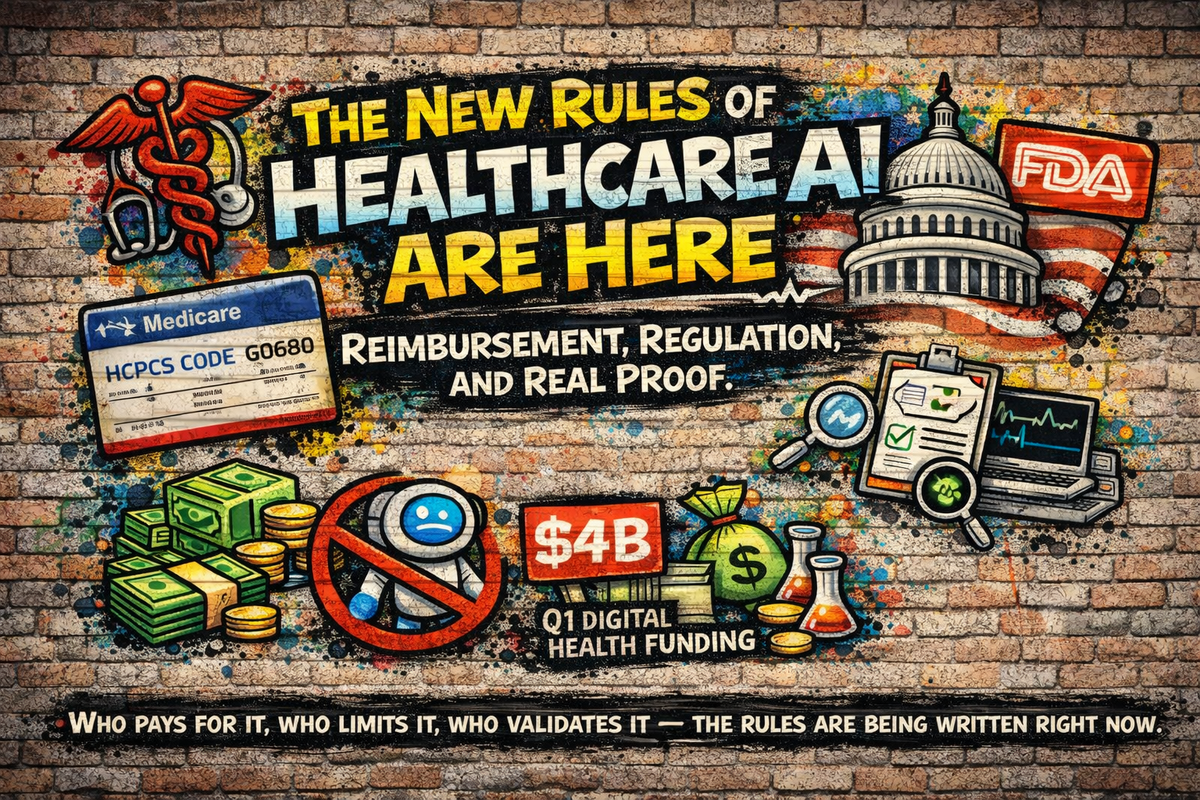
This week the healthcare AI landscape crossed a threshold. CMS created a reimbursement code for AI-detected coronary calcium. The FDA signaled it is moving toward post-market oversight. Four states advanced therapy chatbot bans. The WISeR Medicare pilot launched AI-powered claims review. And Q1 digital health funding hit a record $4 billion.
Underneath all of it runs a single current: the rules governing healthcare AI. Who pays for it, who limits it, and who validates it are being written in real time. The vendors who understand this are preparing for a compliance era. The ones who don't are still writing press releases.
1. Signal Summary
- CMS created HCPCS code G0680 for AI-detected coronary calcium, the first AI-specific outpatient reimbursement code. This is the payment model validation that changes vendor economics.
- The FDA signaled a pivot to post-market AI regulation, reducing pre-market barriers while shifting accountability to real-world performance monitoring. Faster to market, harder to hide failures.
- The WISeR Medicare pilot launched AI-powered claim review for medical necessity, the federal government using AI to audit physician decisions at scale.
- Four states (Maine, Missouri, Tennessee, Georgia) moved therapy chatbot restrictions into law. State fragmentation is now real compliance risk for any behavioral health AI company.
- Q1 2026 digital health funding hit $4B, a record, but nearly 60% concentrated in 12 mega-deals. The barbell is widening between well-funded AI platforms and everyone else.
- Mercyhealth's autonomous coding integration delivered 5.1% revenue lift on live Epic deployment. Revenue cycle AI has moved from demo to documented results.
2. Big Signal of the Week
CMS Creates HCPCS Code G0680: AI Gets Its First Outpatient Reimbursement Line
🔴 Major Signal | Score: 9.0 | View Article
What Happened: CMS published the April 2026 Hospital Outpatient Prospective Payment System update (MM14380) establishing HCPCS code G0680, effective April 1, 2026, to describe software analysis of coronary artery calcium (CAC) and aortic valve calcification from chest CT scans. The update creates a dedicated billing pathway with APC and status indicator assignments for AI-generated cardiac risk insights derived from routine imaging in the hospital outpatient setting.
Why It Matters: This isn't a pilot or a policy discussion. It's a billing code. The moment CMS assigns a reimbursement mechanism to an AI output, the economics of that category permanently change. Every cardiovascular AI vendor now has a payment model to build their business case around. Every health system considering deployment has a revenue line to put in their CFO's pro forma. HeartLung AI and similar players have been waiting for exactly this: an official reimbursement pathway that converts opportunistic AI screening from a cost center into a margin contributor.
Key Details
- Effective date: April 1, 2026
- Code: HCPCS G0680 : software analysis of coronary artery calcium (CAC) and aortic valve calcification from chest CT scans
- Setting: Hospital outpatient prospective payment system
- Mechanism: Dedicated billing pathway with APC and status indicator assignments for AI-generated cardiac risk insights from routine imaging
What This Signals: The G0680 code is the template. If CMS funds opportunistic AI detection on routine cardiac CT, the pattern extends to pulmonary, hepatic, renal, and musculoskeletal applications. The reimbursement frontier just moved.
Strategic Implication: Healthcare AI is heading toward broader reimbursement support, shifting from pilot tools to economically viable components of standard care delivery. The first-mover premium in billing-ready AI is significant.
My Read: The G0680 code is doing more than creating a billing pathway, and it's signaling that CMS is prepared to pay for AI outputs derived from imaging already being performed. That's a different economic logic than standalone AI tools. Opportunistic AI, extracting additional clinical value from scans ordered for other reasons, now has a revenue model. Every AI company in imaging should be asking whether their tool qualifies under this code or can be structured to qualify under the next one. Every health system should be asking which vendors are billing-ready today versus which ones need six months of workflow redesign to get there.
What to Watch: Which imaging AI vendors are positioned to bill under G0680 immediately. Monitor for CMS expansion of similar codes to pulmonary, hepatic, and renal AI applications in the next 12–18 months. Track hospital adoption rates and payer responses as the code moves from announcement to live claims.
Source: Centers for Medicare & Medicaid Services (CMS) — MM14380
3. Real-World Deployments
Mercy Health: Autonomous Coding Delivers 5.1% Revenue Lift on Live Epic Deployment
🔴 Real-World Deployment | Score: 8.5 | View Article
What Happened: Mercy Health implemented Arintra's autonomous coding system, integrated directly into Epic, to handle high-volume routine coding tasks. The system processed over 50,000 charts per month with minimal manual intervention. Results: 5.1% revenue improvement from better capture of delivered care, a 50% reduction in pre-A/R days, fewer denials, and improved coding consistency. The coding team shifted focus to complex cases, denial management, revenue integrity, and provider education without adding headcount.
Why It Matters: Revenue cycle AI has moved from theoretical productivity claims to documented revenue impact. This is a CFO-grade proof point: a named health system, a named EHR, a named dollar outcome, and a specific operational redesign. The 50% reduction in pre-A/R days is almost as significant as the revenue lift, and it means cash is moving faster through the system.
Key Details
- Platform: Arintra autonomous coding, integrated into Epic
- Volume: 50,000+ charts per month with minimal manual intervention
- Revenue impact: 5.1% improvement from better capture of delivered care
- Operational gains: 50% reduction in pre-A/R days, fewer denials, improved audit efficiency
- Labor model: Coding team redirected to complex cases and denial management with no headcount added
What This Signals: AI is maturing from experimental tools to core operational layers in revenue cycle, potentially reshaping labor allocation and financial performance across health systems.
My Read: When revenue cycle AI delivers documented margin improvement at a named health system on a named EHR, procurement conversations at peer institutions accelerate. The RFP clock just started for every non-deployed system. The 50% pre-A/R reduction is the number CFOs will actually care about, which is faster collections without additional staff is a different value proposition than "efficiency gains." Any health system still running manual coding at scale now has a board-presentable peer benchmark working against them.
What to Watch: Expansion to additional specialties and multi-system adoption. Long-term impact on coder roles, denial rates, and whether the revenue lift sustains past the initial deployment window.
Source: Healthcare IT News
Cleveland Clinic and Luminai: Agentic AI Enters Core Administrative Operations
🔴 Real-World Deployment | Score: 8.0 | View Article
What Happened: Cleveland Clinic selected Luminai, a startup building an AI-native platform for complex administrative workflow automation, to automate referral management and operational processes across its system. Luminai's platform ingests documents including faxes, extracts clinical and administrative data, routes referrals, and escalates low-confidence cases to humans. The partnership was announced simultaneously with Luminai's $38M Series B raise led by Peak XV Partners.
Why It Matters: Agentic AI is graduating from back-office curiosity to core operational infrastructure at flagship health systems. This isn't a pilot. It's a system-level administrative automation deal at one of the most influential health systems in the country. Luminai's platform goes beyond simple automation: the knowledge graph and fax-to-data extraction capability addresses one of healthcare's most intractable workflow problems.
Key Details
- Organizations: Cleveland Clinic, Luminai
- Platform: AI-native workflow automation, document ingestion (including faxes), data extraction, knowledge graph, agentic routing
- Use case: Referral management and operational workflow automation at system scale
- Funding context: Coincided with Luminai's $38M Series B, which is a coordinated signal of momentum
Strategic Implication: Healthcare AI is moving toward agentic systems that own end-to-end administrative processes, prioritizing ROI in high-volume tasks like referrals amid labor pressures.
My Read: Cleveland Clinic's vendor selection is often a preview of what the broader market adopts in 18 months. The fax-extraction capability is undersold in most coverage, as fax remains the primary document transport mechanism in healthcare, and a platform that can reliably extract structured data from faxes at scale is solving a real problem that pure AI scribing doesn't touch. The concurrent Series B raise isn't coincidence; it's a coordinated evidence release designed to move procurement conversations at peer institutions.
What to Watch: Deployment timelines and automation metrics at Cleveland Clinic. Whether Luminai secures additional health system partners post-Series B. Evidence of sustained automation rates across document types beyond initial rollout.
Source: Forbes / Becker's Hospital Review / MedCity News
Corewell Health: Remote Patient Monitoring Delivers Documented Hypertension Control Gains
🔴 Real-World Deployment | Score: 8.2 | View Article
What Happened: Corewell Health embedded the Cadence remote patient monitoring platform into primary care workflows and reported quantifiable results: hypertension control improved from 26.7% to 39.5% achieving ≤130/80 in just four months of enrollment. Additional cohort gains in diabetes and heart failure management. The deployment features connected devices, continuous monitoring, closed-loop workflows, and EHR integration with reduced clinician burden.
Why It Matters: AI-enabled RPM is maturing into a primary care standard, not a specialty program. The hypertension number, a 12-point improvement in four months, is a clinical outcome, not an efficiency metric. Corewell's results point to primary care as the fastest-maturing AI deployment category after documentation.
Key Details
- Platform: Cadence RPM, embedded in primary care workflows
- Hypertension result: Control rate improved from 26.7% to 39.5% achieving ≤130/80 in four months
- Additional cohorts: Diabetes and heart failure management gains documented
- Infrastructure: Connected devices, continuous monitoring, closed-loop workflows, EHR integration
- Operational impact: Reduced clinician burden through automated monitoring and workflow
Strategic Implication: Points to growing maturity of AI-enabled remote monitoring as a core tool for scaling chronic disease management, potentially shifting care delivery from reactive to proactive models.
My Read: RPM's real signal isn't the device, it's the workflow integration. A 12-point improvement in hypertension control in four months is the kind of outcome that moves from a vendor case study to a clinical guideline. Corewell's results are structured around a closed-loop workflow, not a bolted-on monitoring app, and that distinction matters for scalability. Any health system running chronic disease management programs without RPM integration now has a documented peer benchmark on hypertension control working against their quality metrics.
What to Watch: Expansion to additional health systems and chronic conditions. Integration with broader AI platforms for predictive analytics and cost reduction metrics beyond clinical outcomes.
Source: Healthcare IT News
Creative Solutions in Healthcare: AI Across 160 Skilled Nursing Facilities
🔴 Real-World Deployment | Score: 8.0 | View Article
What Happened: Creative Solutions in Healthcare rolled out the ExaCare AI platform across 160 skilled nursing facilities to streamline preadmission processes. The platform processed over 1,500 referrals in the first days of deployment, significantly accelerating preadmission workflows and enhancing post-acute care access and hospital collaboration.
Why It Matters: Post-acute AI deployment at scale. The nursing facility sector, historically among the slowest to adopt new technology, is now running agentic admissions automation across 160 sites simultaneously. The speed of the referral processing, 1,500+ in the first days. points to operational impact, not a staged rollout.
Key Details
- Platform: ExaCare AI
- Scale: 160 skilled nursing facilities
- Early metric: 1,500+ referrals processed in the first days of deployment
- Function: Preadmission workflow automation; post-acute care access and hospital collaboration
What This Signals: If AI can handle referral processing at 160 SNFs simultaneously, the staffing model assumptions built into long-term care finance need to be revisited.
My Read: The nursing facility sector is where healthcare AI coverage almost never goes, which is exactly why this deployment matters. 160 sites is not a pilot. That's a rollout. The 1,500-referral figure in the first days suggests the platform was handling real operational volume immediately, not running in parallel with manual processes. Any operator managing SNF referrals manually at scale now has a competitive question to answer about throughput and hospital partnerships.
What to Watch: Follow-up metrics on cost savings, error rates, and time-to-admission. Broader adoption by other post-acute operators and whether the hospital partnership signal translates into preferential referral relationships.
Source: Business Wire
UC Davis Health: AI Embedded in Epic to Track Colonoscopy Quality Metrics Automatically
🔴 Real-World Deployment | Score: 8.2 | View Article
What Happened: UC Davis Health deployed an AI tool embedded within their Epic EMR to automatically analyze pathology reports from colonoscopies, identify adenomatous polyps, and accurately track adenoma detection rates (ADR) in real time. The system supports physicians in comparing their performance against benchmarks and flags outliers without manual chart review.
Why It Matters: Quality measurement that previously required dedicated abstraction teams is now automated inside existing EHR infrastructure. This isn't a new app or a bolted-on system, it's AI embedded into the operational record. ADR is a direct proxy for cancer prevention quality: physicians with lower detection rates have worse patient cancer outcomes.
Key Details
- Tool: AI embedded within Epic EMR
- Function: Automatic analysis of colonoscopy pathology reports; real-time ADR tracking and outlier flagging
- Clinical significance: ADR is a direct proxy for cancer prevention quality, low ADR correlates with worse outcomes
- Operational impact: Eliminates manual chart abstraction for quality reporting; enables real-time benchmarking
Strategic Implication: EHR-embedded AI is quietly taking over quality reporting functions. The hospital that automates measurement gains the ability to intervene faster, and that gap compounds over time.
My Read: EHR-embedded AI for quality measurement is the category most likely to spread fastest and get noticed least until it's everywhere. Once a health system has automated ADR tracking inside Epic, every other quality metric becomes a candidate for the same approach. The outlier flagging function is the one to watch: real-time detection of below-benchmark performance creates accountability pressure that quarterly manual audits never could.
What to Watch: Adoption by additional Epic-using health systems. Publication of longitudinal outcome data on cancer risk reduction. Expansion to other quality metrics within the same EHR-embedded model.
Source: UC Davis Health
4. Market Signals
Waystar Launches AI to Detect Payer 'Silent Denials' and Recover Lost Revenue
🔴 Market Signal | Score: 8.0 | View Article
What Happened: Waystar added Recoupment Manager to its AltitudeAI suite, an AI capability that matches payer recoupments ("silent denials") to originating claims, surfacing revenue losses that previously went undetected. Early pilots showed more than 80% reduction in reconciliation time, and one $4B health system surfaced $32 million in hidden recoupments for review.
Why It Matters: Payer takebacks are one of the most under-tracked revenue leakage categories in healthcare. Silent denials, adjustments that reduce payment without triggering the same workflow as an explicit denial, often go undetected until an audit. Waystar is the first major RCM platform to productize this detection. The $32M figure from a single system is the number that will move procurement conversations.
Key Details
- Product: Recoupment Manager, added to the AltitudeAI suite
- Capability: AI matches payer recoupments to originating claims, surfacing revenue losses that previously went undetected
- Pilot result: >80% reduction in reconciliation time; one $4B system surfaced $32M in hidden recoupments
- Category: First major RCM platform to productize silent denial detection
Strategic Implication: AI is evolving from ancillary tools to autonomous layers in revenue cycle management, where automation directly impacts provider margins. The RCM battleground is moving from claim submission to claim defense.
My Read: The $32 million number from a single $4B health system implies that silent denial exposure scales with revenue. A $2B system might be carrying $15–18M in undetected recoupments. That's not a productivity story, that's a material financial recovery conversation. Waystar productizing this before Epic or Oracle means there's a window where standalone RCM AI can capture the market before EHR incumbents build competing features. That window won't stay open long.
What to Watch: Adoption rates across more providers. Competitive responses from other RCM platforms and EHR incumbents. Whether the $32M figure holds up across different system sizes and payer mixes.
Source: Fierce Healthcare / PR Newswire
CMS Health Tech Ecosystem: First Wave of AI-Powered MVPs Launched
🔴 Market Signal | Score: 8.5 | View Article
What Happened: CMS announced and showcased the first wave of Minimum Viable Products in its Health Tech Ecosystem initiative at an invitation-only April 9 event. Featured platforms include Doctronic for digital medical guidance, January AI for glucose monitoring and predictions, and XCures for oncology treatment options including clinical trials. The initiative includes a new Blue Button API endpoint, identity verification integrations for Medicare beneficiaries, and a stated goal to "unleash AI" on patient-shared data.
Why It Matters: CMS is building the infrastructure to validate and distribute AI health tools at federal scale. This isn't a pilot program, it's a market access mechanism. A vendor in the CMS Health Tech Ecosystem has a federal proof point that changes the payer conversation, the enterprise sales conversation, and the investor conversation simultaneously.
Key Details
- First wave: Doctronic (digital medical guidance), January AI (glucose management), XCures (oncology treatment options and clinical trials)
- Infrastructure: New Blue Button API endpoint, identity verification integrations for Medicare beneficiaries
- Stated goal: To "unleash AI" on patient-shared data via standards-driven interoperability
- Significance: Federally validated marketplace for AI health tools, not a pilot, a distribution mechanism
Strategic Implication: Getting into the CMS Health Tech Ecosystem is becoming a distribution strategy, not just a regulatory milestone. The vendors in the first wave now have a federal proof point to take to enterprise payers, health systems, and investors.
My Read: The Health Tech Ecosystem is a quietly significant development that isn't getting the coverage it deserves. CMS is effectively building a curated app store for AI health tools with Medicare validation attached. That changes vendor positioning fundamentally: a company inside the Ecosystem can tell enterprise buyers they're federally validated; a company outside can't. Watch the second wave announcement carefully, the categories CMS prioritizes will signal where federal reimbursement logic is heading next.
What to Watch: Second wave MVP announcements and the categories CMS prioritizes. Adoption by Medicare providers. Any forthcoming CMS guidance on privacy safeguards or enforcement mechanisms for Ecosystem participants.
Source: Centers for Medicare & Medicaid Services (CMS) / U.S. Department of Health & Human Services
Q1 2026: Digital Health Funding Hits $4B Record, Concentrated in 12 Mega-Deals
🔴 Market Signal | Score: 8.2 | View Article
What Happened: Digital health startups raised $4 billion in Q1 2026 across 110 deals, the strongest quarter since the pandemic peak, according to Rock Health. AI-enabled companies captured the majority of funding. Twelve mega-deals accounted for 59% of total capital, with average deal size climbing to $36.7M. Whoop's $575M Series G led the field.
Why It Matters: The market is polarizing. A small number of scaled AI platforms are attracting institutional capital at a pace that locks in competitive advantages. Early-stage companies in categories already dominated by well-funded incumbents face a compressed path to Series A and beyond.
Key Details
- Total raised: $4 billion across 110 deals, strongest Q1 since the pandemic peak
- Concentration: 12 mega-deals captured 59% of total capital
- Average deal size: $36.7M, up significantly from prior quarters
- Top deal: Whoop, $575M Series G
- AI share: AI-enabled companies captured the majority of funding
Strategic Implication: Healthcare AI investment is shifting toward consolidation, favoring established platforms with proven traction over fragmented early-stage ventures. Capital is increasingly a competitive moat.
My Read: The middle of the digital health market is under severe pressure. Vendors raising at Series A in a category already dominated by a well-funded incumbent face an increasingly difficult path to institutional scale. Health systems should be evaluating vendor financial stability as part of procurement, a technically capable company raising a $15M Series A in a category where a competitor just closed $200M is a different kind of risk than it was two years ago.
What to Watch: Follow-on rounds and acquisitions among top-funded companies. Q2 funding data for confirmation of sustained AI dominance. Whether concentration continues or capital begins flowing to earlier-stage companies in new AI subcategories.
Source: Rock Health / Healthcare Dive / Fierce Healthcare
Adonis Raises $40M Series C for AI Revenue Cycle Orchestration
🔴 Market Signal | Score: 8.0 | View Article
What Happened: Adonis, an AI orchestration platform for revenue cycle management, raised $40M Series C to expand its AI agent products for payer interactions, denial management, and claims automation across health systems. The company cited rapid revenue growth and named health system customers including Mount Sinai as proof points.
Why It Matters: Revenue cycle AI is no longer a feature, it's a stand-alone category attracting serious growth capital. Adonis's raise at Series C with named health system customers signals that the RCM orchestration market is beginning to consolidate around platforms, not point solutions.
Key Details
- Raise: $40M Series C
- Focus: AI agents for payer interaction, denial management, and claims automation
- Anchor customer: Mount Sinai (named proof point)
- Category signal: RCM orchestration emerging as a stand-alone platform category
Strategic Implication: The RCM category is consolidating around orchestration layers. Vendors offering point solutions inside a broader orchestration competitor's territory are at structural risk.
My Read: Adonis joining Waystar, Arintra, and similar players in the RCM AI category at growth-stage capital creates a market structure question: which company owns the orchestration layer and which ones become features? Mount Sinai as a named customer is doing political work in CFO offices at peer institutions right now. Health systems evaluating RCM AI should be asking whether they're buying a platform or a point solution, that distinction will determine whether they're locked into an incumbent's roadmap or positioned to switch as the category evolves.
What to Watch: Adonis's expansion of AI agents into new payer interactions and denial management workflows. Adoption metrics from additional health systems. Competitive responses from EHR incumbents building similar orchestration capabilities.
Source: Healthcare IT Today
5. Policy and Regulation
FDA Signals Post-Market AI Regulation Shift: Faster to Market, Harder to Hide Failures
🔴 Policy / Regulation | Score: 8.5 | View Article
What Happened: FDA senior adviser Jared Seehafer announced at HIMSS that the agency is moving from its current 90–95% pre-market focus to a more balanced approach: lighter pre-market review, heavier post-market performance monitoring. The FDA has already approved more than 1,000 AI products in healthcare. A request for information on the new framework is forthcoming. The agency explicitly rejected a proposal to broadly deregulate AI devices, maintaining that oversight, just rebalanced , remains essential.
Why It Matters: Post-market regulation means health systems become the real-world validation environment for AI tools, whether they opt in or not. Building infrastructure to monitor AI performance in deployment is no longer optional; it's the regulatory model.
Key Details
- Announced by: FDA senior adviser Jared Seehafer at HIMSS 2026
- Shift: From 90–95% pre-market focus to balanced approach: lighter pre-market review, heavier post-market monitoring
- Context: FDA has already approved 1,000+ AI health products
- Deregulation rejected: FDA explicitly rejected a proposal to deregulate certain AI device categories
- Next step: Request for information on the new framework forthcoming
Strategic Implication: Healthcare AI is heading toward faster market entry with accountability shifted to ongoing monitoring, balancing innovation speed against safety risks. Health systems are the new validation infrastructure.
My Read: The post-market shift is the most consequential regulatory development this year and it's getting underreported. It means health systems are now the real-world evidence generators for AI tools they've deployed. That's a governance obligation that most health system IT departments aren't currently resourced to fulfill. The vendors who understand this are building monitoring infrastructure. The ones who don't are selling into a regulatory environment they haven't modeled. Health system executives who signed AI contracts without performance monitoring provisions should be revisiting those agreements now.
What to Watch: The FDA's forthcoming request for information and subsequent framework details. Industry responses on post-market surveillance feasibility and cost. Whether health systems begin building AI performance monitoring infrastructure as a procurement requirement.
Source: Chief Healthcare Executive / STAT News
CMS WISeR Pilot: AI Now Reviews Medicare Claims for Medical Necessity
🔴 Policy / Regulation | Score: 8.2 | View Article
What Happened: CMS launched the WISeR (Wasteful and Inappropriate Service Reduction) pilot, deploying AI to review Medicare claims for medical necessity in select service categories. The program targets up to 25% of wasteful healthcare spending. Critics including physicians and legislators raised concerns about AI interference in doctor-patient relationships and potential for delayed care. The Electronic Frontier Foundation filed suit seeking transparency on vendor agreements and bias evaluations.
Why It Matters: AI is now reviewing physician decisions at the payer level with federal authority. This is not a future scenario, it is live. Health systems in pilot markets need compliance infrastructure today. The EFF lawsuit signals that transparency and bias accountability will be part of the governance story for this program going forward.
Key Details
- Program: WISeR (Wasteful and Inappropriate Service Reduction)
- Function: AI reviews Medicare claims for medical necessity in select service categories
- Target: Up to 25% of wasteful healthcare spending
- First federal use: AI as a primary claims auditing mechanism in Medicare
- Legal challenge: EFF filed suit seeking transparency on vendor agreements and bias/accuracy evaluations
Strategic Implication: Accelerating use of AI in policy tools to enforce cost controls, potentially reshaping provider-payer interactions and prioritizing efficiency in public health programs.
My Read: The WISeR pilot is doing two things simultaneously: establishing AI as a legitimate tool for claims review and creating the template for what accountability looks like when that AI makes a wrong call. The EFF lawsuit is the governance mechanism working as designed, it will force CMS to disclose how accuracy and bias are being evaluated, which means those standards will eventually become the floor for any AI operating in federal claims review. Health systems in pilot markets should be treating WISeR as a compliance audit, not an administrative update.
What to Watch: Pilot outcomes on denial rates, appeal success, and actual waste reduction. Court rulings or CMS responses to the EFF suit. Any expansion to additional services or geographic regions.
Source: USA Today Network / Healthcare Dive
State Therapy Chatbot Bans Are Accelerating: Maine, Missouri, Tennessee, Georgia
🔴 Policy / Regulation | Score: 8.0 | View Article
What Happened: Four states advanced or enacted therapy chatbot restrictions in a single week. Maine sent LD 2082 to the governor, prohibiting AI from replacing licensed human therapists while allowing administrative applications. Missouri's HB 2372 advanced with $10,000 penalties for violations. Tennessee Governor Lee signed SB 1580 prohibiting AI from being marketed as a qualified mental health professional, with enforcement through private right of action and civil penalties up to $5,000 per violation. Georgia passed related AI restrictions.
Why It Matters: Behavioral health AI is entering a compliance minefield. Four states in one week is not a trend, it's a market structure change. The private right of action in Tennessee is particularly significant: it enables individual patients to sue, not just regulators to penalize.
Key Details
- Maine (LD 2082): Sent to governor, it prohibits AI from replacing licensed therapists in therapy, psychotherapy, and diagnosis; allows administrative AI
- Missouri (HB 2372): Advanced with $10,000 penalties per violation
- Tennessee (SB 1580): Signed into law April 1, prohibits marketing AI as a qualified mental health professional; private right of action; civil penalties up to $5,000 per violation
- Georgia: Passed related AI restrictions and disclosure requirements
Strategic Implication: Healthcare AI is heading toward fragmented state-by-state governance in behavioral health, prioritizing human oversight over rapid tech deployment. This creates a national compliance patchwork that favors well-resourced incumbents over early-stage behavioral health AI companies.
My Read: The private right of action in Tennessee is the development most behavioral health AI companies haven't fully modeled. Regulatory fines are a cost of doing business; individual patient lawsuits are an existential risk for a startup. Any company marketing an AI mental health product needs a legal audit of every state they operate in and a clear line between what the product does and what a "qualified mental health professional" does. That line is getting harder to defend as AI capabilities advance. One week, four states. The compliance map is being drawn fast.
What to Watch: Governor approvals in Maine and Missouri. Similar bills advancing in additional states. Whether federal harmonization efforts from HHS or FDA emerge to preempt state-by-state fragmentation. Litigation under Tennessee's private right of action.
Source: Transparency Coalition / Troutman Pepper Privacy + Cyber + AI
6. Funding Signals
Yuzu Health ($35M) and Insight Health ($11M): Capital Flows to the Agentic Infrastructure Layer
🔴 Funding Signal | Score: 7.0 | View Article
Funding Context: Two raises on the same week point at the same thesis. Yuzu Health closed a $35M Series A, backed by General Catalyst and Anthropic's Anthology Fund, to build AI-native health plan infrastructure for claims and RCM automation. Insight Health raised $11M Series A led by Standard Capital (with Pear VC and Kindred Ventures) to scale its clinical AI agent platform covering patient intake, referrals, and EHR documentation. Insight has already completed over 3 million autonomous patient interactions.
Why Capital Is Flowing Here: These aren't bets on AI features inside existing platforms. They're bets on AI-native companies owning the infrastructure layer outright, one on the payer side (Yuzu), one on the front-office clinical side (Insight). The Anthropic Anthology Fund backing Yuzu is a notable investor signal: it's an AI-native fund deploying into healthcare infrastructure, not just clinical AI tooling.
Key Details
- Yuzu Health: $35M Series A; investors include General Catalyst and Anthropic's Anthology Fund; focus on AI-native health plan infrastructure, claims and RCM automation
- Insight Health: $11M Series A led by Standard Capital; platform automates patient intake, referrals, and EHR documentation; 3 million+ autonomous patient interactions completed
- Combined thesis: Agentic AI owning end-to-end workflows, not augmenting existing ones, at both the payer and clinical access layer
Strategic Implication: Capital is accelerating toward AI-native platforms that control entire workflow categories rather than integrate into existing ones. The companies building on top of EHRs or payer systems are increasingly competing against companies that are architecturally designed to replace those workflows entirely.
My Read: The Anthropic Anthology Fund backing Yuzu is the detail worth lingering on. Anthropic's investment arm isn't backing a chatbot or a copilot, it's backing health plan infrastructure. That's a signal about where AI-native architecture is expected to create durable competitive advantage: not at the application layer, but at the plumbing layer that processes claims, routes referrals, and handles the operational logic that legacy systems do slowly and expensively. Insight's 3 million autonomous patient interactions is the traction number that separates this from a pure directional bet, that's real volume running through an agentic system, not a demo. Together, these raises describe a market where the infrastructure for AI-native healthcare operations is being funded in parallel at both the clinical front door and the payer back office.
What to Watch: Named health system or health plan partnerships from Yuzu post-raise. Insight's next deployment metrics, does autonomous interaction volume scale proportionally with the capital, or does growth slow as complexity increases? Whether Anthropic's Anthology Fund makes additional healthcare infrastructure bets that clarify where it sees the AI-native wedge.
Source: Fierce Healthcare / MobiHealthNews
7. Research Breakthroughs
AI Uncovers Significant Lung Cancer Misdiagnoses, Treatment Decision Impact Documented
🔴 Research Breakthrough | Score: 8.2 | View Article
What Happened: A study published in JAMA Network Open found that clinicians using an AI algorithm identified a 3.1% misdiagnosis rate in 3,958 lung carcinoma cases, specifically in lung squamous cell carcinoma typing. These weren't near-misses: the errors had already influenced treatment decisions and patient outcomes before AI review.
Why It Matters: AI is not just improving diagnostic speed. It is surfacing errors the existing clinical system already made. A 3.1% misdiagnosis rate across nearly 4,000 cases means approximately 123 patients in this study alone received care based on an incorrect diagnosis. This is a different category of value proposition than efficiency, and a different category of liability conversation.
Key Details
- Published in: JAMA Network Open
- Finding: 3.1% misdiagnosis rate identified in 3,958 lung carcinoma cases
- Error type: Lung squamous cell carcinoma typing misclassification
- Impact: Misdiagnoses had already influenced treatment decisions and patient outcomes before AI review
- Implication: AI surfacing pre-existing errors, not just preventing future ones
Strategic Implication: AI is advancing toward routine integration in molecular profiling to enhance diagnostic accuracy, potentially shifting oncology from human-led to AI-assisted pathology for better patient outcomes.
My Read: When AI identifies misdiagnoses that changed patient treatment, oncology executives have both a clinical obligation and a risk management question: what does it mean if you had access to this tool and didn't deploy it? The 3.1% figure isn't dramatic in isolation, but applied to the volume of lung cancer diagnoses at a major cancer center, it becomes a quality assurance failure that's hard to justify not addressing. This study is the kind of evidence that moves from a journal to a legal brief.
What to Watch: Adoption rates in clinical pathology labs. Integration into standard oncology workflows and guidelines. Follow-up studies measuring treatment outcome improvements in patients where AI correction changed the diagnosis.
Source: Healthcare IT News / JAMA Network Open
EcoRxAgent: AI Agent Generates Lower-Cost Therapeutically Equivalent Prescriptions (Nature)
🔴 Research Breakthrough | Score: 8.2 | View Article
What Happened: A study in Nature npj Digital Medicine describes EcoRxAgent, an AI agent that generates prescriptions by retrieving drug candidates, verifying safety, and outputting lower-cost therapeutically equivalent alternatives at the point of care. Tested on 1,559 prescriptions from two cohorts, it achieved cost reductions of 14.40% to 40.14% without inferiority to physician prescriptions.
Why It Matters: Agentic AI is entering the prescribing workflow not as a copilot but as an economic optimizer. The paper validates the safety of the approach in a peer-reviewed format across real-world prescriptions, not a simulated dataset. A 14–40% cost reduction range is material in a healthcare system under sustained cost pressure.
Key Details
- Published in: Nature npj Digital Medicine
- Tested on: 1,559 prescriptions from two real-world cohorts
- Cost reduction: 14.40% to 40.14% without inferiority to physician prescriptions
- Process: Retrieves drug candidates, verifies safety, analyzes cost-effectiveness, outputs lower-cost equivalents at point of care
What This Signals: Healthcare AI is heading toward agentic tools that automate economic optimization in care delivery, potentially reshaping prescribing workflows amid rising costs and value-based care demands.
My Read: PBMs, payers, and value-based care programs should be watching this closely. If AI agents can reliably generate cost-equivalent prescriptions with peer-reviewed validation, the formulary negotiation landscape shifts, and so does the question of whether that negotiation needs to happen at all. The 40% upper bound on cost reduction is the number that will get attention in pharmacy benefit meetings. The peer-reviewed validation is what separates this from vendor marketing.
What to Watch: Adoption in real-time clinical settings. Integration with EHRs and pharmacy benefit managers. Prospective studies measuring long-term outcomes and physician acceptance.
Source: Nature npj Digital Medicine
8. Trend to Watch
The AI Accountability Stack Is Being Built From Both Directions
For the past three years, healthcare AI governance has been a conversation, an important one, but largely unresolved. This week it started becoming infrastructure. From the top, CMS is using AI to review physician claims under WISeR. The FDA is shifting to post-market surveillance models that make real-world performance data the primary evidence standard. State legislatures are passing laws with private rights of action that put individual patient enforcement behind behavioral health AI restrictions.
From the ground, peer-reviewed research is establishing clinical benchmarks that vendors will be measured against rather than alongside. JAMA's scribe study didn't validate ambient AI, it created the comparison baseline that every ambient AI vendor now has to answer to. The lung cancer misdiagnosis study didn't just prove AI's diagnostic value; it created a liability framework for health systems that have access to tools like this and choose not to deploy them.
What's forming is an accountability stack: regulatory frameworks at the top, clinical evidence benchmarks in the middle, and legal liability pathways at the bottom. The vendors who survive the next 24 months will be the ones who understood that proof is the new product. The G0680 reimbursement code is the reward at the top of that stack, but only for tools that can clear every layer beneath it.