
The proof era has arrived: AI claims are now being tested like drugs, and health systems are paying attention.
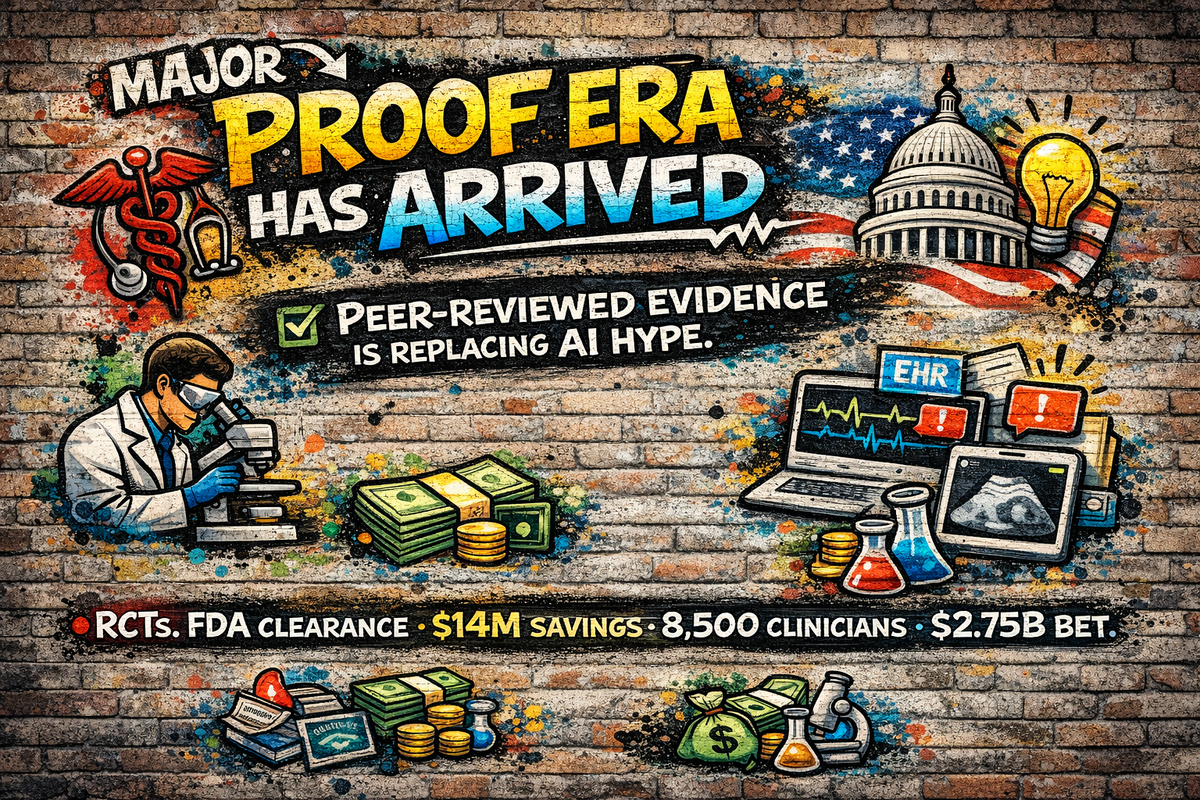
This week it looks as if the era of vendor-led proof points is ending. Peer-reviewed trials, multicenter studies, and scale decisions driven by documented outcomes are replacing the pilot press release. Procurement committees now have evidence to demand. Health systems that already deployed are separating from those still evaluating.
JAMA Scribe Study: 8,500 Clinicians, Five Systems, Peer-Reviewed. The Hype Gap Just Closed
🔴 Major Signal | Score: 8.2 | View Article
Why It Matters The largest peer-reviewed AI scribe study ever published: 8,500+ clinicians, five academic centers, two years of data. Results are real but measured, 16 minutes saved per shift, one extra patient seen every two weeks, meaningful burnout reduction. The headline isn't the number. It's that we finally have evidence instead of vendor claims, published in JAMA.
Key Details
- Scope: 5 academic medical centers, 8,500+ clinicians, 2023–2025
- Outcomes: 16 min/shift documentation reduction, 13 min/shift EHR reduction
- Revenue impact: ~1.7% weekly visit volume increase (~$167/month per clinician)
- Notable: Greater benefits in primary care and for female clinicians
- Published: JAMA
What This Signals
The ROI case for ambient AI now has a peer-reviewed floor. Modest, not transformational, but real. Vendors overpromising dramatic productivity gains now have a published benchmark to answer to.
My Read: The real story here isn't the 16 minutes. It's that vendors have been selling ambient AI without a credible benchmark to defend against. That benchmark now exists, and it's modest. Health system executives who were promised transformational productivity gains now have peer-reviewed grounds to push back hard on vendor pricing models. The primary care advantage buried in this data deserves its own conversation: if the gains concentrate there, specialty deployments need to be renegotiated on different terms. The gender differential is the signal most coverage seemed to skip entirely, and it points at documentation burden as a systemic inequity, not just an efficiency problem. JAMA publishing this is the credentialing moment that moves ambient AI from sales pitch to procurement line item.
Source: Healthcare Dive
Texas Children's Hospital: $14M Annual Savings, AI-RFID Integration Moves Beyond Pilot
🔴 Real-World Deployment | Score: 8.5 | View Article
Why It Matters
Not a pilot. Not a projection. Texas Children's is documenting $14M in annual savings from RFID-AI pharmacy inventory integration live across its system, integrated directly with Epic Willow. This is what it looks like when operational AI matures past the press release, a named system, a hard number, and a workflow redesign that freed pharmacists for higher-value work.
Key Details
- Organization: Texas Children's Hospital
- Partners: Tecsys, Terso, Zebra, Epic
- Technology: RFID-driven inventory automation integrated with Epic Willow
- Outcome: $14M annual savings on high-cost medications
- Operational impact: Automated cycle counts, improved expiration visibility, pharmacist time shifted to proactive tasks
What This Signals
Back-office AI with documented ROI at this scale is becoming the standard CFOs will demand before approving any future AI investment. Texas Children's just set the bar.
My Read: What separates this story from a hundred other healthcare AI announcements is the specificity. It has named partners, named EHR integration, and a named dollar figure. That specificity is doing political work inside every other health system CFO's office right now. The pharmacist labor reallocation piece is undersold: this isn't just cost reduction, it's a workflow redesign that changes what a pharmacist's job actually is. Any health system still running manual cycle counts on high-cost medications is now measurably behind. The Epic Willow integration detail matters more than it looks, as it signals this isn't a bolt-on, it's embedded in the operational record. CFOs will bring this case study into the next AI budget conversation whether vendors want them to or not.
Source: Healthcare IT News
University of Toledo Health Scales Nabla. The Scale Decision Is the Signal
🔴 Real-World Deployment | Score: 8.0 | View Article
Why It Matters
This isn't a pilot announcement. Toledo Health evaluated Nabla's ambient AI, documented faster chart closure, reduced documentation burden, and improved revenue cycle performance across multiple specialties, and then made the scale decision. The decision to expand is qualitatively different from a deployment press release. It means the evidence held up internally.
Key Details
- Organizations: University of Toledo Health, Nabla
- Stage: Post-pilot enterprise scale decision
- Outcomes: Faster chart closure, reduced documentation burden, improved revenue cycle performance
- Specialties: Multiple
What This Signals
Ambient AI that survives internal evaluation and earns a scale commitment is the minority. Toledo's decision signals what separates deployments that stick from pilots that quietly expire.
My Read: Most ambient AI coverage celebrates the pilot. Toledo's story is about what comes after the pilot, and that's a much harder thing to earn. Internal evaluation is where vendor claims go to die quietly; Toledo's scale decision means Nabla's evidence held up under scrutiny from people who had no incentive to be generous. The revenue cycle improvement angle is the one health systems need to hear loudest: documentation reduction that also accelerates billing is a different value proposition than documentation reduction alone. This story also implicitly asks a question the industry avoids: what happened to all the pilots that didn't scale? That's where the real pattern lives. Toledo's decision is a signal about vendor survival, not just product performance.
Source: PR Newswire
Butterfly Network FDA Clearance: AI Performs Sonographer-Level Gestational Age Assessment with No Sonographer Required
🔴 Policy / Regulation | Score: 8.0 | View Article
Why It Matters
FDA cleared an AI tool that lets any healthcare worker, not just trained sonographers, perform gestational age assessments with equivalent accuracy. Already deployed in Uganda and Malawi via the Gates Foundation. Cleared March 30. This is the evidence-to-clearance pipeline working as designed: validated tool, regulatory approval, live deployment in underserved markets.
Key Details
- Organizations: Butterfly Network, Gates Foundation
- FDA clearance: March 30, 2026
- Capability: Automated gestational age estimation (16–37 weeks) via handheld blind-sweep ultrasound
- Accuracy: Equivalent to trained sonographer
- Active deployments: Uganda, Malawi
- Target expansion: U.S. rural markets
What This Signals
AI is eliminating the specialist bottleneck in diagnostics. FDA clearance is the proof point that regulators are willing to validate tools that democratize expert-level capability, and the model will replicate across dozens of diagnostic categories.
My Read: The Gates Foundation deployment in Uganda and Malawi isn't the soft-market story it looks like. It's the validation cohort that made FDA clearance possible. Regulators cleared a tool already proven in resource-constrained environments, which inverts the usual evidence-gathering model. The specialist elimination signal here is structural: if gestational age assessment doesn't require a sonographer, the question becomes which diagnostic categories are next and how fast the clearance pipeline can move. Rural Tennessee is the right frame for domestic impact, not because it's a feel-good angle, but because rural market access is where U.S. health systems are most exposed on workforce. Health system executives in underserved markets should be tracking this clearance date as a procurement trigger, not a research curiosity.
Source: HIT Consultant
Eli Lilly's $2.75B Insilico Bet: Pharma Stops Experimenting with AI and Starts Depending on It
🔴 Funding Signal | Score: 8.2 | View Article
Why It Matters Lilly isn't funding a research collaboration, it's paying $115M upfront for platform access with $2.75B in milestone potential. That's not experiment money. That's infrastructure money. The deal signals that Lilly's R&D leadership has seen enough evidence from Insilico's pipeline to treat AI-driven discovery as a core dependency, not a supplement.
Key Details
- Organizations: Insilico Medicine, Eli Lilly
- Deal: $115M upfront, up to $2.75B in milestones plus tiered royalties
- Platform: Pharma.AI (PandaOmics + Chemistry42)
- Focus: Novel oral therapeutics across multiple therapeutic areas
- Context: 173 AI-discovered programs now in clinical development industry-wide
What This Signals Big Pharma's transition from AI curiosity to AI dependency is happening faster than most health system leaders realize. When the evidence is strong enough, the capital follows at a scale that reshapes entire markets.
My Read: The upfront $115M number is the tell. Milestone structures let acquirers hedge; front-loading $115M signals Lilly's leadership isn't hedging, they've already seen enough from Insilico's pipeline to treat platform access as a non-negotiable. With 173 AI-discovered programs now in clinical development industry-wide, this deal isn't Lilly taking a flier on an interesting technology. It's Lilly deciding they cannot afford to be late to infrastructure that competitors are already building on. Health system leaders should read this as a forcing function: when pharma R&D starts treating AI as a core dependency at this capital scale, the clinical tools that feed into those pipelines get prioritized differently. The drug discovery conversation and the clinical AI conversation are now financially connected in ways that weren't true 18 months ago.
Source: MobiHealthNews
Baylor, Yale, Mayo Peer-Reviewed Studies Validate AI in Utilization Management... Simultaneously
🔴 Research Breakthrough | Score: 8.2 | View Article
Why It Matters Three flagship U.S. health systems Baylor Scott & White, Yale New Haven, and Mayo Clinic published independent peer-reviewed studies validating the same AI platform in utilization management. Level-of-care accuracy, observation discharge rates, operational forecasting. This kind of multi-system convergence on a single vendor's evidence base doesn't happen by accident.
Key Details
- Organizations: Xsolis, Baylor Scott & White Health, Yale New Haven, Mayo Clinic
- Domain: Utilization management
- Outcomes: Improved level-of-care accuracy, observation discharge rates, operational forecasting
- Evidence: Multiple independent peer-reviewed studies published simultaneously
What This Signals When Baylor, Yale, and Mayo all publish peer-reviewed evidence for the same platform, the procurement conversation shifts from "does this work" to "why haven't you deployed it yet." That's the pressure this creates on every comparable health system.
My Read: Three flagship systems publishing independent peer-reviewed evidence for the same platform at the same moment is not a coincidence. It's a coordinated evidence release, and the coordination itself is the story. Xsolis understood that a single study from one system creates a conversation; simultaneous publication from Baylor, Yale, and Mayo creates a procurement mandate. The utilization management domain is strategically chosen: it sits at the intersection of clinical judgment and revenue protection, which is exactly where health system executives are most anxious about AI accountability. Any comparable health system that hasn't evaluated this platform now has a defensibility problem when their board asks why not. The more important signal is what this coordinated evidence strategy reveals about how mature AI vendors are learning to move procurement cycles, not through sales, but through peer pressure dressed as research.
Source: Globe Newswire
🏆 WEEKLY SCOREBOARD — Top 12 Stories
Ranked by Signal Strength Score. Week of April 4, 2026.
- 8.5 | Deployment | MUSC Health Uses AI Analytics to Gain OR Scheduling Efficiencies — Ambient AI delivers 6x timestamp accuracy and measurable idle time reduction in MUSC's operating rooms.
- 8.5 | Policy | HHS AI Strategy: April 3 Compliance Deadline Hits — HHS's 21-page AI strategy took effect this week, mandating bias mitigation and human oversight for all high-impact AI systems in federal health programs.
- 8.5 | Deployment | Texas Children's Hospital Saves $14M Annually with RFID-AI Pharmacy Integration — Live system-wide deployment documents hard ROI on high-cost medication inventory automation.
- 8.5 | Deployment | Geisinger AI Drives 200%+ Colonoscopy Increase and 43% Mortality Reduction — Human-AI hybrid model produces measurable cancer screening gains and mortality reduction at a named health system.
- 8.2 | Deployment | Salesforce VA Rollout: Agentic AI Enters Core Operations Across 150 Facilities — First large-scale U.S. healthcare deployment of agentic AI running care coordination and incident response.
- 8.2 | Policy | Four States Advance Healthcare AI Legislation in a Single Week — Georgia, Utah, Alabama, and Tennessee each passed distinct AI restrictions, creating a national compliance patchwork.
- 8.2 | Policy | HHS Reinstates ONC and Centralizes AI Governance — HHS restores ONC as singular health IT policy office and consolidates AI, data, and tech leadership under OCIO.
- 8.2 | Research | JAMA AI Scribe Study: 8,500 Clinicians, 5 Systems, Peer-Reviewed — Largest real-world scribe study replaces vendor claims with hard evidence: 16 minutes saved per shift.
- 8.2 | Research | Tempus-Medtronic ALERT Trial: RCT Proves AI EHR Alerts Change Cardiology Care — Cluster-randomized trial across 35 hospitals shows AI notifications increase valve procedure rates 40%.
- 8.2 | Research | 97.8% Sensitivity: AI Liquid Biopsy for Prostate Cancer Validated in Multicenter Study — PanGIA Biotech's urine-based AI diagnostic validated across 26 U.S. urology practices.
- 8.2 | Funding | Eli Lilly Signs $2.75B AI Drug Discovery Deal with Insilico Medicine — Largest pharma-AI collaboration to date signals generative AI is now core R&D infrastructure, not an experiment.
- 8.2 | Research | Radiologists Spot AI-Generated Deepfake X-Rays Only 75% of the Time — RSNA study exposes diagnostic imaging vulnerability, raising authentication and patient safety governance questions.
Healthcare AI Signal is a high-signal briefing on the developments actually shaping AI in healthcare. Its lens is inspired by street art: honest, urgent, and grounded in what is really happening, not just what official narratives choose to highlight.