
The Regulator Just Moved the Map
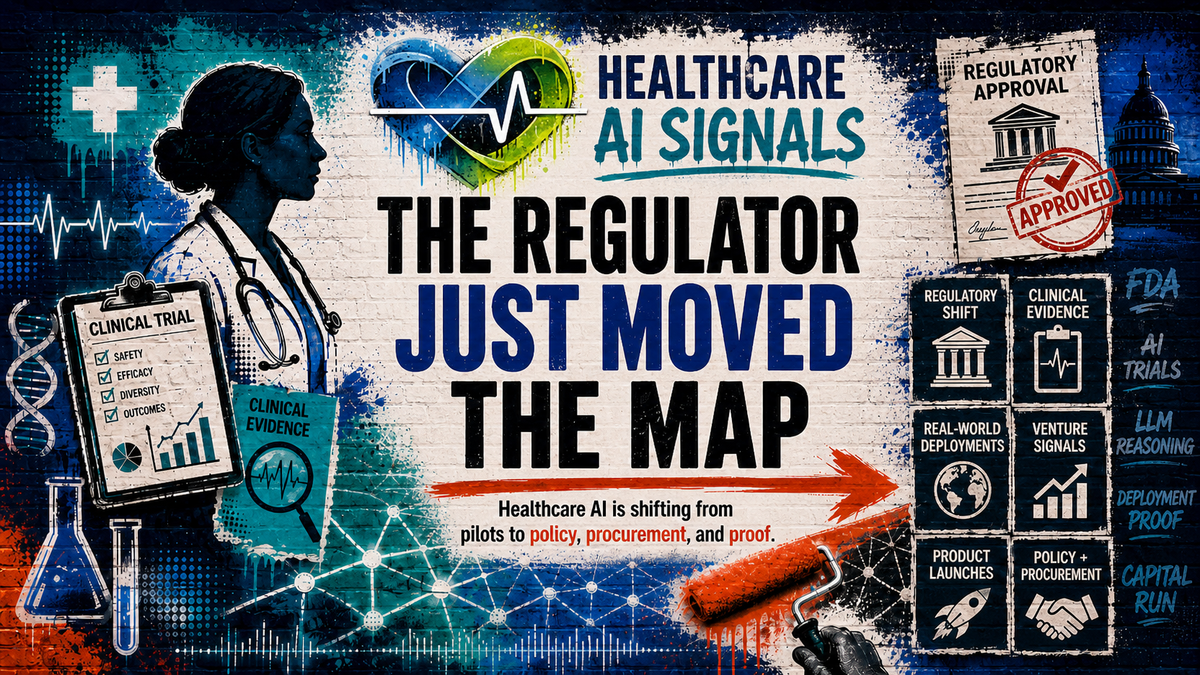
This week, the regulator wrote the script. FDA opened the door on AI-monitored real-time clinical trials with named pharma collaborators. Science published peer-reviewed evidence of physician-level LLM reasoning. OpenEvidence, reportedly used by 40% of US physicians, pulled its product from the EU and UK over AI Act uncertainty. Pharma extended its AI capital run with Lilly's $2.25B Profluent recombinases deal, and Anthropic acquired Coefficient Bio.
The pre-2026 era debated whether AI would matter in healthcare. The era starting this week is being decided in regulatory filings and procurement committees, not research labs. Health systems still arguing about pilot scope are about to find that the map has been redrawn around them.
Executive Read Healthcare AI is entering its regulatory and evidence phase. FDA is creating pathways for AI-native clinical trials. The EU is becoming a market-access constraint. Peer-reviewed evidence is raising the bar for clinical AI validation. And the best deployment stories now include named systems, EHR integration, and measurable workflow impact.
For healthcare leaders, the next question is no longer “should we pilot AI?” It is “which AI use cases can survive regulatory review, board scrutiny, procurement diligence, and operational scale?”
1. Signal Summary
- FDA opened the door on AI-monitored clinical trials, with a pilot involving AstraZeneca, Amgen, Paradigm Health, MD Anderson, and Penn that could compress drug approval cycles by 20–40%.
- OpenEvidence, used by 40% of US physicians, pulled its clinical decision support tool from EU and UK markets, citing EU AI Act regulatory uncertainty.
- Science published peer-reviewed evidence of LLMs performing physician-level reasoning, joined the same week by Harvard's o1 ER triage study (67% accuracy vs. 50–55% for physicians).
- Pharma's AI capital extended its run. Eli Lilly committed up to $2.25B to Profluent for AI-designed recombinases (a separate transaction from the previously-covered Insilico deal), and Anthropic acquired Coefficient Bio for ~$400M.
- Mayo Clinic's pancreatic cancer pre-diagnostic AI was validated with ~73% sensitivity on prediagnostic CTs up to three years before clinical diagnosis, published in Gut.
- Kettering Health documented a 77% clinician time reduction in post-implant heart failure care via Story Health, Epic, and Abbott. Alongside CCS's CeeCee agentic platform handling >90% of chronic care calls at scale, these were the only two deployments with hard achieved metrics this week.
2. Big Signal of the Week
FDA Advances Real-Time Clinical Trials, Signaling Regulatory Support for AI in Drug Development
🔴 Major Signal | Score: 8.5 (High Signal) | View Article
Why It Matters This is a regulatory architecture change, not a technology demo. FDA Commissioner Marty Makary announced a pilot using AI and cloud computing to monitor clinical trial data in real time, projecting that the approach could compress trial duration by 20–40% and shave years off approval timelines by replacing the periodic data freeze model with continuous oversight. Once the pathway is real, the cost of not designing trials around continuous AI monitoring becomes a competitive disadvantage.
Key Details
- Agencies: FDA (Commissioner Marty Makary)
- Named collaborators: AstraZeneca, Amgen, Paradigm Health, MD Anderson, University of Pennsylvania
- Mechanism: AI plus cloud computing for real-time clinical trial data monitoring
- Projected impact: 20–40% reduction in trial duration, years off drug approval timelines
- Companion action: FDA RFI on AI governance in early-phase trials (Score: 8.0); summer pilot launch
- Alignment: NIST AI Risk Management Framework
What This Signals FDA is treating AI-native data flows as a first-class trial methodology, and the named co-pilot list reads like a who's-who of pharma's most aggressive AI adopters. Health system research offices that haven't yet built a real-time data export capability are about to be deprioritized in pharma site-selection conversations.
My Read: The named collaborator list is doing political work most coverage missed. AstraZeneca, Amgen, Paradigm Health, MD Anderson, and Penn weren't randomly selected; they're the operators FDA wanted anchoring this precedent. By the time the pilot reports out, "AI-monitored trial" reads as default, not experiment. Any CRO or academic site without real-time data export gets priced out of pharma site selection. Pair this with FDA's prior post-market shift and AIM-NASH validation, and the agency has now leaned forward on the entire trial-to-deployment lifecycle. The question for health system research offices: do your IRB workflows, EHR data export pipelines, and AI tooling survive a pharma due-diligence question they weren't being asked 90 days ago?
Source: U.S. Food and Drug Administration
3. Real-World Deployments
Kettering Health Cuts Post-Implant Heart Failure Clinician Time by 77%
🔴 Real-World Deployment | Score: 8.2 | View Article
Why It Matters This is the AI deployment story operators have been asking for: named system, named integration partners, named clinical domain, and a hard, defensible operational number. Kettering Health implemented Story Health's Epic-connected platform integrating Abbott's CardioMEMS/Merlin data, automating documentation write-back and adding protocol-driven RN care extension. Documentation reduction stories saturated 2025; this story is workflow redesign in a high-acuity domain with device telemetry already in the EHR.
Key Details
- Organization: Kettering Health
- Vendor and partners: Story Health, Abbott (CardioMEMS / Merlin), Epic
- Domain: Post-implant heart failure care
- Documented outcomes: ~77% reduction in clinician time on post-implant tasks; routine diuretic adjustments shortened from ~7.5 minutes to ~1.5 minutes
- Workflow design: Protocol-driven RN care extension and patient coaching
- Integration depth: Documentation auto write-back to Epic
What This Signals Chronic care domains with rich device data are now the cleanest entry point for embedded AI ROI. The pattern Kettering ran is replicable across CHF, CIED, diabetes, COPD remote monitoring, and post-surgical orthopedic recovery. Health systems with CardioMEMS deployments and no automated workflow yet are visibly behind a published peer benchmark.
My Read: What separates Kettering from a hundred other ambient AI announcements is that the number isn't a productivity vibe. It's a workflow redesign with a 7.5-to-1.5-minute timestamp on a specific clinical action. That specificity is doing political work inside every health system CFO's office right now. The RN care-extension piece is undersold: this isn't just clinician time reduction, it's a workforce redesign that changes what an RN's job is in chronic HF management. The Epic, Abbott, and Story Health stack is a reference architecture story; the EHR-native integration is what makes the metric defensible to a board. CFOs are bringing this case study into the next AI budget conversation.
Source: Healthcare IT News
CCS Deploys CeeCee Agentic AI: Live at >90% of Inbound Chronic Care Calls
🔴 Real-World Deployment | Score: 7.2 | View Article
Why It Matters Agentic AI in chronic care management has crossed from concept to a quantified operational throughput number. CCS rolled out an enterprise multi-agent agentic AI platform (CeeCee) across chronic care and supply operations. The platform is live at scale, autonomously resolving routine patient interactions, speeding supply fulfillment, and answering inbound calls.
Key Details
- Organization: CCS (chronic care management)
- Partner: Deloitte
- Platform: CeeCee multi-agent agentic AI
- Documented outcome: >90% of inbound current-customer calls handled at production scale
- Projected outcome: >30% annual operating cost savings
- Scope: Chronic care delivery and supply operations (enterprise-wide)
What This Signals Agentic AI is no longer competing on whether it works, it's competing on call-handling percentages and cost-savings projections. The procurement conversation in chronic care management is shifting from "does this work" to "why is your vendor's number lower than CCS's?"
My Read: The 90% figure will be quoted in the next twenty agentic-AI sales decks, but the more interesting number is the cost-savings projection above 30%. That projection only holds if the human capacity displaced by the agent gets redeployed into higher-value work; otherwise the savings disappear into administrative drag. CCS knows this, which is why the deployment was paired with Deloitte's operating model work, not just a tech rollout. For chronic care competitors evaluating agentic AI, the procurement question to add this quarter: show the throughput percentage, the cost-savings methodology, and the redeployment plan for displaced FTEs. Vendors that answer all three will close deals; vendors that answer only the first will compete on price.
Source: Fierce Healthcare
4. Market Signals
Anthropic Acquires Coefficient Bio for ~$400M, Frontier Lab Enters Drug Discovery Directly
🔴 Market Signal | Score: 8.0 | View Article
Why It Matters Anthropic's first material life sciences acquisition signals that frontier AI labs are now operating directly in drug discovery, not licensing into it. Combined with the Roche/NVIDIA partnership, OpenAI's life-sciences moves, and the broader Lilly-Profluent and Lilly-Insilico capital pattern, the AI-pharma corporate boundary is dissolving at the structural level.
Key Details
- Acquirer: Anthropic
- Target: Coefficient Bio
- Reported deal value: ~$400 million
- Context: First major frontier AI lab life-sciences acquisition
- Comparable moves: Roche/NVIDIA partnership, Lilly/NVIDIA, OpenAI life sciences expansion
- Reported by: PharmaVoice, April 28, 2026
What This Signals The AI labs are buying biological insight directly, not consuming it through licensing or partnerships. Expect M&A in both directions: AI labs acquiring biology, pharma acquiring AI talent.
My Read: Anthropic appointing Vas Narasimhan to its board was the early signal; Coefficient Bio is the operational follow-through. Frontier AI labs are not staying upstream as model providers. They're vertically integrating into drug discovery, building enterprise life-sciences capability inside their own walls. For pharma BD teams, the question shifts from "which AI vendor do we license" to "do we partner with frontier labs as customers, or compete with them as platform builders." For AI vendors building on frontier model APIs, the question is whether differentiation survives if the underlying lab acquires biology assets directly. If OpenAI or Google DeepMind makes a comparable life-sciences acquisition within two quarters, the pharma-AI corporate boundary will have dissolved.
Source: PharmaVoice
TytoCare Secures FDA De Novo for AI-Powered Eardrum Analysis, Creating a New Regulatory Category
🔴 Market Signal | Score: 8.0 | View Article
Why It Matters First FDA De Novo classification for AI-powered eardrum image analysis, establishing a new regulatory category for AI diagnostic aids in remote/virtual care. The De Novo pathway is becoming a category-creation tool for AI specialty diagnostics.
Key Details
- Vendor: TytoCare
- Product: Tyto Insights™ for ENT Suite
- Regulatory milestone: FDA De Novo classification (April 27, 2026)
- Capability: AI-powered eardrum image analysis for virtual care
- Significance: First FDA De Novo for an AI ENT diagnostic aid; new regulatory category created
- Use case context: Telehealth and remote care workflows
What This Signals Regulatory pathway creativity is a competitive moat. Vendors that can navigate De Novo are establishing platforms in categories that didn't formally exist 12 months ago. Watch for next-wave clearances in dermatology, otoscopy, and ophthalmology AI diagnostic aids.
My Read: The De Novo classification is more interesting than the AI itself, because the FDA is creating regulatory plumbing for a category that didn't have a clearance pathway. Regulatory category creation is now part of the AI vendor playbook, not just an outcome. Rural and pediatric primary care is where this matters most: TytoCare's eardrum analysis becomes a defensible specialty-extension tool with a regulatory anchor, which means rural systems facing ENT specialist shortages just got a procurement option that didn't exist 30 days ago. For investors, the De Novo pathway should be evaluated as a competitive moat in any AI diagnostic vendor due-diligence. The next 18 months will produce a wave of similar categories, and vendors that file first will own them.
Source: PR Newswire / TytoCare
5. Policy and Regulation
OpenEvidence Withdraws Clinical AI from EU and UK Markets, Citing AI Act Uncertainty
🔴 Policy / Regulation | Score: 8.5 (High Signal) | View Article
Why It Matters A platform used by 40% of US physicians and processing 18M monthly clinical consultations cited regulatory uncertainty as the reason it cannot operate in Europe. This is the cleanest signal yet that the global AI vendor map is bifurcating.
Key Details
- Vendor: OpenEvidence (clinical decision support AI)
- US adoption: ~40% of US physicians; ~18M monthly consultations
- Action: Withdrawal from EU and UK markets
- Cited reason: EU AI Act regulatory uncertainty for clinical decision support
- Consequence: Millions of potential clinical consultations lost in EU/UK
What This Signals US-headquartered AI healthcare companies should expect EU market access to be a 2027–2028 conversation, not a 2026 one. EU-headquartered systems should expect a slower vendor menu. The bifurcation has operational and capital consequences.
My Read: OpenEvidence isn't a fringe vendor. When 40% of US physicians use a tool and that tool exits an entire continent, it's not a compliance hiccup, it's a market structure event. Every cross-border investor and global health system CIO needs to model this quarter whether the bifurcation is durable or temporary. My base case is durable through 2027 at minimum. The AI Act creates compliance ambiguity that small and mid-cap AI vendors cannot afford alongside US scaling. The European clinical AI market will be served by EU-native vendors with smaller capital bases or by US giants willing to operate parallel compliance organizations. Most US AI vendors will choose neither and stay home. For US health systems with European operations, this is a vendor-availability problem for the audit committee agenda this quarter.
Source: Let's Data Science
EU AI Act Delays High-Risk Medical Device Enforcement to 2028, Maintains 2026 Transparency Requirements
🔴 Policy / Regulation | Score: 8.2 | View Article
Why It Matters The European Commission's AI Act Omnibus negotiations delayed high-risk AI enforcement until August 2028 while maintaining transparency requirements for generative AI models by August 2026. EU-deployed systems get extended runway on high-risk classification, but transparency obligations are still on a 2026 timeline.
Key Details
- Regulatory body: European Commission
- High-risk AI enforcement: Delayed to August 2028
- Generative AI transparency: Required by August 2026
- Eudamed database: Mandatory use of first four modules begins May 2026
- Companion funding: €63M for AI in screening and data spaces
- Companies in "data-cleansing frenzy" to meet registration requirements
What This Signals EU-operating health systems get short-term flexibility on high-risk device integration but unchanged transparency obligations. The delay is itself a market signal. Brussels recognized the friction the OpenEvidence exit measures and is loosening one constraint while keeping another.
My Read: The delay is framed as a win for AI deployment, but the underlying signal is that high-risk medical device provisions were forcing market exits the Commission did not anticipate. Pulling enforcement to 2028 is regulatory capture in slow motion: vendors created enough exit pressure that the Commission moved. The August 2026 transparency requirement for generative AI is the one with operational teeth. It requires documentation, model-card disclosure, and audit trails most healthcare AI products are not built around. Health system CIOs in EU jurisdictions should be auditing vendor transparency as a procurement precondition this quarter. The €63M screening funding is the carrot to the transparency stick: Brussels offers money to systems that build compliantly while the August deadline punishes those that don't.
Source: Healthcare.digital
KFF: Federal Deregulation May Speed AI Healthcare Adoption While Widening Disparities
🔴 Policy / Regulation | Score: 8.0 | View Article
Why It Matters KFF's analysis argues that federal executive orders prioritizing AI innovation over equity mandates may speed deployment but reduce external compliance pressure on bias and equity. Public AI use for health information is rising, but trust is low and biased datasets risk widening racial and ethnic disparities.
Key Details
- Source: KFF (Kaiser Family Foundation), April 30, 2026
- Topic: AI in healthcare and implications for disparities
- Federal posture: Trump administration executive orders prioritizing innovation over equity mandates
- Risk identified: AI-exacerbated racial and ethnic disparities through biased datasets
- State context: State-level AI regulations may face federal preemption pressure
- Public use: Rising AI use for health information; trust remains low
What This Signals Internal bias audits and equity assessments are about to become the load-bearing governance function. Federal deregulation reduces external compliance pressure but heightens internal disparity risks. Health systems leaning on federal compliance signals as their equity floor are about to find that floor has lowered.
My Read: The KFF analysis is the policy-side counterweight to this week's deregulatory tilt. Federal executive orders favoring innovation are real, and they reduce the compliance cost of US AI deployment in the short term. They also reduce the compliance signal, the external pressure that has historically forced health systems to invest in bias auditing and equity testing. Boards outsourcing equity governance to federal compliance frameworks are about to find that framework has thinned. The strategic implication: build a board-presentable internal equity-testing protocol this quarter, before disparity-related litigation or media coverage forces it under emergency conditions. Vendors that survive the next 24 months in clinical AI will be the ones whose products have documented bias-mitigation work, even when the federal floor doesn't require it.
Source: KFF
6. Funding Signals
Eli Lilly Commits Up to $2.25B to Profluent for AI-Designed Recombinases
🔴 Funding Signal | Score: 8.2 | View Article
Why It Matters This is a separate, distinct transaction from Lilly's previously-covered Insilico Pharma.AI deal. Profluent specifically targets AI-designed site-specific recombinases for gene editing, while Insilico is general drug discovery (PandaOmics, Chemistry42). Lilly running parallel platform commitments at this scale is a portfolio-level signal: AI-native R&D infrastructure is now a basket of necessary bets, not a single vendor evaluation.
Key Details
- Pharma sponsor: Eli Lilly
- AI partner: Profluent (Bezos Expeditions investor)
- Deal value: Up to $2.25B in milestones
- Capability: AI-designed site-specific recombinases for genetic medicine
- Application: Large-scale, precise DNA editing beyond conventional gene editing systems
- Therapeutic focus: Diseases without current effective therapies
- Distinct from: Lilly-Insilico Pharma.AI deal (covered prior issues)
What This Signals Pharma is now treating AI-native genetic medicine tooling as foundational R&D infrastructure across multiple distinct platform bets. AI platforms with credible biology output are commanding pharma-platform capital, not project capital.
My Read: The headline number is $2.25B, but the more important signal is that Lilly is now running parallel platform bets: Insilico for general discovery, Profluent for gene editing, presumably more on the way. That's not vendor evaluation, that's portfolio construction at the platform layer. For mid-cap pharma watching this, the question is whether they can afford comparable parallel commitments or cede entire therapeutic categories. AI-designed recombinases address diseases conventional CRISPR can't reliably edit, which means Lilly is building structural advantage in therapeutic categories that didn't have viable AI-native pathways 18 months ago. For health system leaders, the ripple is that drug discovery AI and clinical AI are now financially linked.
Source: Business Wire / Profluent
Aidoc Closes $150M Series E Led by Goldman Sachs, Reaching $500M+ Total Funding
🔴 Funding Signal | Score: 8.2 | View Article
Why It Matters Clinical imaging AI has reached the scale where Goldman-led growth equity is the right capital structure. Aidoc's platform analyzes 60M+ patient cases annually across nearly 2,000 hospitals worldwide, with 31 FDA clearances spanning multiple diagnostic use cases. The Series E brings total funding to over $500M.
Key Details
- Company: Aidoc (clinical AI imaging)
- Round: $150M Series E
- Lead investor: Goldman Sachs Growth Equity
- Other investors: General Catalyst, SoftBank, NVIDIA
- Total funding: $500M+
- Operating scale: 60M+ patient cases analyzed annually
- Hospital footprint: Nearly 2,000 hospitals worldwide
- Regulatory breadth: 31 FDA clearances
What This Signals Clinical imaging AI is consolidating around proven enterprise platforms. Sub-scale point solutions face a narrowing window. Imaging AI procurement at scale should now privilege FDA-clearance breadth and named-system reference depth, both of which Aidoc has at scale most competitors cannot match.
My Read: Goldman-led growth equity into clinical imaging AI in the same week as Lilly's Profluent deal isn't coincidence. It's the same investor base making the same bet at different parts of the value chain. Clinical AI vendors with pharma R&D adjacency (imaging, lab, genomics, real-world data) are about to see a capital advantage over pure clinical-workflow vendors. The 31 FDA clearances number is the moat most coverage skipped. Any imaging AI competitor with two or three clearances now has to explain why their narrower scope is a feature, not a limitation. The procurement question to add this quarter: walk us through your roadmap for matching Aidoc's clearance breadth, or explain why narrow specialization is the better fit.
Source: Axios
7. Research Breakthroughs
Science Publishes Peer-Reviewed Evidence of LLMs at Physician-Level Reasoning
🔴 Research Breakthrough | Score: 8.5 (High Signal) | View Article
Why It Matters This is the validation paper at the highest publication tier. Science published evidence that an LLM matches physicians on reasoning-intensive medical tasks, the credentialing moment that pairs with prior reasoning-skeptic publications to bracket the actual evidence range.
Key Details
- Publication: Science (peer-reviewed)
- DOI: 10.1126/science.adz4433
- Finding: LLM demonstrates physician-level reasoning on medical tasks
- Date: April 30, 2026
- Implication: Closes the "is the model good enough?" question at top-tier publication
What This Signals Validation architecture and integration depth are now the binding constraint on clinical AI deployment, not model capability. The conversation moves from "does the model reason correctly" to "what oversight architecture do we deploy around it."
My Read: Science publishing physician-level reasoning is the credentialing moment that moves clinical reasoning AI from sales pitch to procurement line item. Pair this with Mayo Clinic's pancreatic cancer paper in Gut and Harvard's o1 ER triage study in the same week, and the publication cluster is clear: peer-reviewed top-tier journals are now publishing AI-outperforms-baseline evidence at scale. Boards will start asking for the validation architecture, not the productivity metric, as the primary procurement evidence. Health systems whose AI committees run on adoption-rate dashboards instead of validation-and-monitoring frameworks are about to find that the questions getting asked at the next board meeting have shifted.
Source: Science
Mayo Clinic AI Detects Pancreatic Cancer Up to 3 Years Before Clinical Diagnosis
🔴 Research Breakthrough | Score: 8.2 | View Article
Why It Matters Mayo's REDMOD radiomics model analyzed nearly 2,000 routine abdominal CTs and identified prediagnostic pancreatic cancer cases up to three years earlier than clinical diagnosis. The validation study, published in Gut, sets up the prospective AI-PACED clinical trial.
Key Details
- Organization: Mayo Clinic (with NIH support)
- Model: REDMOD radiomics AI
- Dataset: ~2,000 routine abdominal CT scans
- Headline finding: 73% prediagnostic detection at median ~16 months before clinical diagnosis (up to 3 years early)
- Publication: Gut (peer-reviewed)
- Next step: Prospective clinical testing (AI-PACED trial)
- Workflow context: Detection on routine CTs ordered for other reasons (opportunistic screening)
What This Signals AI detection on existing imaging workflows is the lowest-cost-of-deployment entry point for pre-symptomatic screening. High-risk cohort programs are the obvious near-term application. Pancreatic cancer's poor survival rates make this the highest-impact early-detection opportunity in oncology.
My Read: The REDMOD model isn't running on dedicated screening protocols; it's analyzing CTs already ordered for other clinical reasons. That distinction matters operationally because it removes the cost-of-deployment barrier that has historically constrained pre-symptomatic detection AI. Any system already running abdominal CTs has the imaging substrate without new equipment, protocols, or staffing. The 16-month median lead time translates into oncology workflow planning: high-risk cohort identification, surveillance scheduling, workup acceleration. The AI-PACED prospective trial is what to watch. If it replicates retrospective sensitivity in a live workflow, the pancreatic AI category becomes a procurement priority for any cancer center within 18 months.
Source: Mayo Clinic News Network
Harvard Study: OpenAI's o1 Outperforms ER Physicians on Triage Accuracy
🔴 Research Breakthrough | Score: 8.2 | View Article
Why It Matters A Harvard study found OpenAI's o1 model outperformed physicians in emergency triage diagnoses (67% accuracy vs. 50–55%), with 82% accuracy when given more clinical detail. In treatment planning, the gap was wider (89% vs. 34%).
Key Details
- Institution: Harvard
- Model evaluated: OpenAI o1
- Triage diagnostic accuracy: 67% AI vs. 50–55% physicians; 82% with additional details
- Treatment planning accuracy: 89% AI vs. 34% physicians
- Setting: Emergency department triage scenarios
- Coverage: The Guardian, Harvard Magazine, NPR (multiple outlets confirmed)
What This Signals ED clinical decision support evaluation now has an evidence anchor that wasn't available 90 days ago. AI is advancing toward reliable augmentation in diagnostic workflows, not just documentation.
My Read: The 89% vs. 34% treatment planning gap shouldn't get buried under the triage accuracy headline. Treatment planning is where physician judgment is supposed to be most valuable, and where AI is theoretically most constrained. A 55-point gap in favor of AI on a Harvard-led evaluation resets the clinical-AI conversation. Three caveats matter: this is one study, one model, and triage simulations are not live ED conditions. But evidence accumulates, and this study pairs with the Science reasoning paper and Mayo's Gut publication to form the strongest peer-reviewed publication cluster healthcare AI has produced in any single week. ED operational leaders should be thinking now about how AI triage decision support gets piloted, not whether it should be.
Source: The Guardian
8. Weekly Scoreboard: Top 10 Stories
Ranked by Signal Strength Score. Week of April 26, 2026.
- 8.5 | Policy: FDA Advances Real-Time Clinical Trials: Regulatory architecture for AI-monitored trials with named pharma collaborators.
- 8.5 | Research: LLMs Demonstrate Physician-Level Reasoning (Science): Top-tier peer-reviewed validation of clinical reasoning AI.
- 8.5 | Policy: OpenEvidence Withdraws from EU/UK Markets: 40%-of-US-physicians platform exits Europe over AI Act.
- 8.2 | Research: Mayo Clinic Pancreatic Cancer Pre-Diagnosis: 73% sensitivity 3 years pre-diagnosis on routine CTs.
- 8.2 | Research: Harvard ER Triage Study (OpenAI o1): o1 outperforms ER physicians on triage and treatment planning.
- 8.2 | Deployment: Kettering Health 77% Clinician Time Reduction: Only deployment with hard achieved metrics this week.
- 8.2 | Funding: Aidoc $150M Series E: Goldman-led growth equity into clinical imaging AI.
- 8.2 | Funding: Eli Lilly $2.25B Profluent Recombinases Deal: Pharma platform-bet portfolio expands beyond Insilico.
- 8.2 | Policy: EU AI Act Delays High-Risk Device Enforcement: Short-term flexibility, August 2026 transparency deadline holds.
- 8.0 | Market: Anthropic Acquires Coefficient Bio (~$400M): First major frontier lab life sciences acquisition.
9. Noise of the Week
Hippocratic AI Launches Polaris 5.0, Claims to Outperform Frontier Models
🟡 Major Product Launches | Score: 4.0 | View Article
Why It Looks Important A healthcare-specialized AI model claiming to outperform every frontier model on critical medical tasks, regulatory compliance, empathy, and conversational consistency. In a week dominated by Science-published reasoning research and FDA regulatory action, a vendor claiming a benchmark win could read as part of the validation cluster.
Why It Is Actually Noise Internal benchmarks. No independent peer-reviewed validation. No named deploying customers. No live workflow data. The "outperforms every frontier model" framing arrived in the same week as a peer-reviewed Science paper on physician-level reasoning. That is what evidence looks like; this is what marketing looks like. Hippocratic AI did reach unicorn status this quarter (per prior coverage), but a unicorn round is a capital event, not a clinical validation event.
My Read: Specialized healthcare AI vendors are going to claim performance benchmarks against frontier models for the next 18 months. Most claims will be internal benchmarks against datasets the vendor curated. Procurement teams should ask three questions before placing any of these on a vendor evaluation grid: Where is the peer-reviewed validation? Which named customers are deploying at production scale and what outcomes have they published? What does the model's failure mode look like in adversarial clinical scenarios? Polaris 5.0 may eventually be a real product. The press release is not yet evidence that it is.
Source: Morningstar / PR Newswire
Healthcare AI Signal is a high-signal briefing on the developments actually shaping AI in healthcare. Its lens is honest, urgent, and grounded in what is really happening, not just what official narratives choose to highlight.